
States in the Senate | Texas Timeline
1836

March 2
Months after the Texas Revolution had begun, Texas officially declared its independence from Mexico. Four days later a group of Texas settlers were defeated by Mexican troops at the Battle of the Alamo, near modern-day San Antonio.
1836

April 21
The Texas army, led by future senator Sam Houston, decisively defeated the Mexican army, led by their president, General Antonio Lopez de Santa Ana, at the Battle of San Jacinto, near modern-day Houston. Weeks later a peace agreement was signed allowing for the creation of the Republic of Texas.
1836

October 22
Former congressman and Tennessee governor Samuel Houston became the first president of the Republic of Texas. Houston, originally from Rockbridge County, Virginia, served in that position until 1838 and again from 1841 to 1844. He later represented Texas in the United States Senate.
1844
June 8
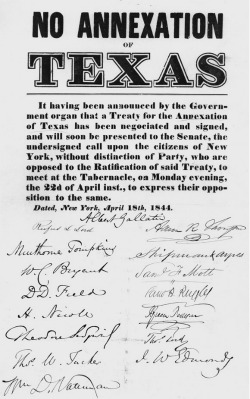
By a vote of 16 to 35, the Senate rejected a treaty to annex the Republic of Texas and assume its debts.
1845
February 27
The Senate voted 27 to 25 in favor of a joint resolution consenting to the annexation of the Republic of Texas. The resolution also provided the conditions for the admission of the State of Texas into the Union.
1845
December 29
Texas became the 28th state in the Union.
1846

February 21
Thomas J. Rusk of Nacogdoches and Samuel Houston of Raven Hill were elected as the first United States senators from the State of Texas.
1846

March 26
Thomas Rusk presented his credentials and took his oath of office. Sam Houston did the same on March 30, following which the senators drew lots to determine their class assignments. Senator Houston drew Class 1, with a term to expire March 3, 1847. Senator Rusk drew Class 3, with a term to expire March 3, 1851.
1846
May 12
The Senate voted 40 to 2 in favor of a bill (H.R. 145) officially declaring a state of war with Mexico. The U.S.-Mexican War (1846–1848) was fought primarily over the annexation of Texas.
1857
March 14
The Senate elected Thomas J. Rusk as president pro tempore. He held the post until July 29, 1857.
1861
February 23
Texas, after a voter referendum, seceded from the Union.
1861

July 11
Senators John Hemphill and Louis T. Wigfall were expelled from the Senate, along with eight other senators, for disloyalty to the Union. Hemphill went on to represent Texas in the Confederate Congress as did Wigfall, who also served in the Confederate army. Texas's two Senate seats remained vacant until 1870.
1870

March 31
After Texas was allowed to resume representation in the U.S. Congress, Morgan C. Hamilton of Austin and James W. Flanagan of Flanagans Mills were administered the oath of office and took their seats. Due to the Civil War, they were the first senators from Texas since 1861.
1873

December 4
James W. Flanagan became chairman of the Senate Committee on Education and Labor (today's Committee on Health, Education, Labor, and Pensions), a position he held until 1875.
1879

March 19
Richard Coke of Waco became chairman of the Senate Committee on Indian Affairs, a position he held until 1881.
1905

February 25
Marble statues of Stephen F. Austin and Sam Houston were added to the Capitol's National Statuary Hall Collection. Austin is known as the founder of the State of Texas. Houston was a soldier-statesman who fought in the War of 1812, served as a congressman, governor of Tennessee, president of the Republic of Texas, senator, and governor of the State of Texas.

1913

March 15
Charles A. Culberson became chairman of the Senate Committee on the Judiciary, a position he held until 1919.
1916

November 7
Charles A. Culberson won reelection and became Texas's first directly elected senator after the ratification of the Seventeenth Amendment in 1913.
1925

February 3
The Senate voted to settle the contested 1922 election between George E. B. Peddy and Earle B. Mayfield of Austin. After a year-long investigation, a recount of disputed ballots, and a Senate review of state primary election regulations, the Senate voted for Mayfield to retain his seat.
1929

March 6
Morris Sheppard of Texarkana was elected the Senate Democratic whip, a position he held until 1933.
1933

March 4
John Nance Garner of Detroit, Texas, was sworn in and began presiding over the Senate as the 32nd vice president of the United States.
1933

March 9
Morris Sheppard became chairman of the Senate Committee on Military Affairs (todays' Committee on Armed Services), a position he held until 1941.
1933

March 9
Texan Chesley W. Jurney became the Senate sergeant at arms, a position he held until January 31, 1943, when he withdrew his name from consideration after becoming embroiled in a conflict between the Senate's majority leader and a filibustering senator.
1938

Congress approved the purchase of a portrait of Vice President John Nance Garner by artist Howard Chandler Christy.
1941

April 9
Morris Sheppard, Texas's longest-serving senator, died while still in office. Senator Sheppard first took his oath of office on February 3, 1913, and served continuously for over 28 years.
1941

June 2
Andrew Jackson Houston took the oath of office and made history, at the age of 86, as the oldest freshman senator ever. Senator Houston was the son of one of Texas's first senators, Samuel Houston. He had been appointed by Texas governor W. Lee (Pappy) O'Daniel on April 21, 1941, to the fill the vacancy caused by the death of Morris Sheppard. O'Daniel went on to win the special election to fill the vacancy, and began serving on August 4, 1941.
1941

July 31
Thomas T. Connally of Marlin became chairman of the Senate Committee on Foreign Relations, a position he held until 1947, and again from 1949 to 1953.
1943

April 16
A marble bust of former vice president John Nance Garner by sculptor James Earle Fraser was dedicated in the Senate wing of the Capitol and added to the Senate Vice Presidential Bust Collection.
1949

August 18
The Senate confirmed the nomination of former attorney general Tom C. Clark of Dallas as an associate justice of the Supreme Court.
1951
January 2
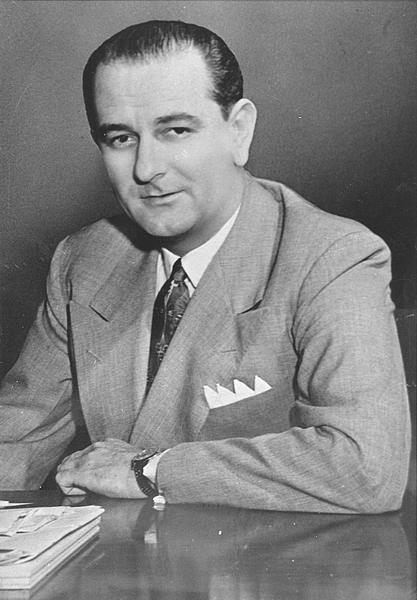
Senator Lyndon B. Johnson of Johnson City was elected Democratic whip, a leadership position he held until advancing to party leader in 1953.
1953
January 2
Senator Lyndon B. Johnson was elected Democratic leader, Conference chairman, and Policy Committee chairman. Two years later, Johnson became majority leader, a position he held until his resignation in 1961.
1958
August 24
Lyndon B. Johnson became chairman of the newly created Senate Committee on Aeronautical and Space Sciences (today's Committee on Commerce, Science, and Transportation), a position he held until 1961.
1961

January 20
Lyndon B. Johnson, who had resigned from the Senate on January 3, was sworn in and began presiding over the Senate as the 37th vice president of the United States.
1964

January 10
Former senator Samuel Houston was featured on a five-cent U.S. postage stamp. Houston had previously been depicted on a three-cent stamp in 1936 to commemorate the centennial of Texas independence.
1964
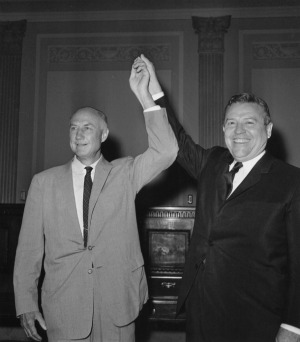
July 9
Senator Ralph W. Yarborough of Austin got into a wrestling match with Senator Strom Thurmond of South Carolina outside a Senate committee room. Senator Thurmond had been attempting to block access to the room to prevent a vote. The two 61 year old men grappled on the floor before they were separated.
1966

A marble bust of former vice president Lyndon B. Johnson by sculptor JIMILU mason was completed. The formal addition of the bust to the Senate Vice Presidential Bust Collection was delayed by protocol, as former vice president Richard M. Nixon's bust had yet to be unveiled.
1969

January 14
Senator Ralph W. Yarborough became chairman of the Senate Committee on Labor and Public Welfare (today's Committee on Health, Education, Labor, and Pensions), a position he held until 1971.
1972
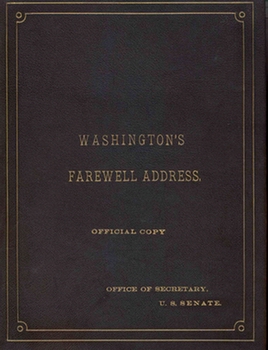
February 21
Lloyd M. Bentsen Jr. of Austin read George Washington's 1796 Farewell Address in the Senate Chamber, a tradition dating to 1862.
1973

January 3
John G. Tower of Wichita Falls became the chairman of the Republican Policy Committee, a position he held until 1985.
1973

August 27
Former senator, vice president, and president Lyndon B. Johnson was featured on an eight-cent U.S. postage stamp. Based on a portrait of Johnson by artist Elizabeth Shoumatoff, the stamp was unveiled on what would have been Johnson's 65th birthday. Johnson was featured again on a twenty-two-cent stamp in 1986.
1980
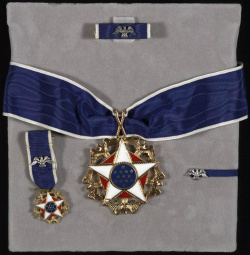
June 9
Former senator and vice president Lyndon B. Johnson was posthumously awarded the Presidential Medal of Freedom by President Jimmy Carter. The medal is one of the country's highest civilian awards and is bestowed upon individuals who have made "an especially meritorious contribution to the security or national interests of the United States, world peace, cultural or other significant public or private endeavors."
1981
January 5
John G. Tower became chairman of the Senate Committee on Armed Services, a position he held until 1985.
1981

January 20
Texan George H. W. Bush was sworn into office and began presiding over the Senate as the 43rd vice president of the United States.
1987

January 6
Lloyd M. Bentsen Jr. became chairman of the Senate Committee on Finance, a position he held until 1993.
1988
November 8
Senator Lloyd M. Bentsen Jr. ran unsuccessfully for vice president on the Democratic ticket with presidential candidate Michael Dukakis, the Massachusetts governor. They lost the election to the incumbent vice president, George H. W. Bush and his running mate, Indiana senator Dan Quayle.
1990

June 27
A marble bust of former vice president George H. W. Bush by sculptor Walker Kirtland Hancock was dedicated in the Senate wing of the Capitol and added to the Senate Vice Presidential Bust Collection.
1990

November 13
Senator Phil Gramm of College Station was elected chairman of the Republican Senatorial Campaign Committee, a position he held until 1995.
1993

January 20
The Senate confirmed the nomination of Senator Lloyd M. Bentsen Jr. as secretary of the treasury under President Bill Clinton. Bentsen resigned his Senate seat that same day and served as treasury secretary until 1994.
1999
January 7
Phil Gramm became chairman of the Senate Committee on Banking, Housing and Urban Affairs, a position he held until 2001.
1999
August 11
Former senator Lloyd M. Bentsen Jr. was awarded the Presidential Medal of Freedom by President Bill Clinton. The medal is one of the country's highest civilian awards and is bestowed upon individuals who have made "an especially meritorious contribution to the security or national interests of the United States, world peace, cultural or other significant public or private endeavors."
2000

December 5
Senator Kay Bailey Hutchison of Galveston, who became Texas's first woman senator in 1993, was elected Republican Conference vice chair (formerly the Republican Conference secretary). She served in that position until 2007, when she became chair of the Republican Policy Committee, a position she held until 2009.
2004
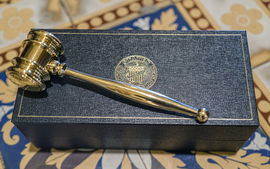
February 6
John Cornyn of Houston received the Golden Gavel Award for presiding over the Senate for 100 hours in a single session.
2006

November 15
Senator John Cornyn was elected Republican Conference vice chair, a position he held until 2009, when he became chairman of the Republican Senatorial Campaign Committee. In December 2012, he was elected Republican whip, or assistant Republican leader for the 113th–115th Congresses.
2025

January 7
Ted Cruz of Houston became chairman of the Senate Committee on Commerce, Science, and Transportation.