

About Historic Rooms | Minton Tiles
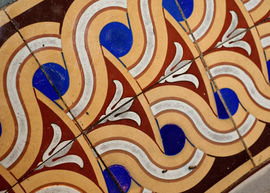
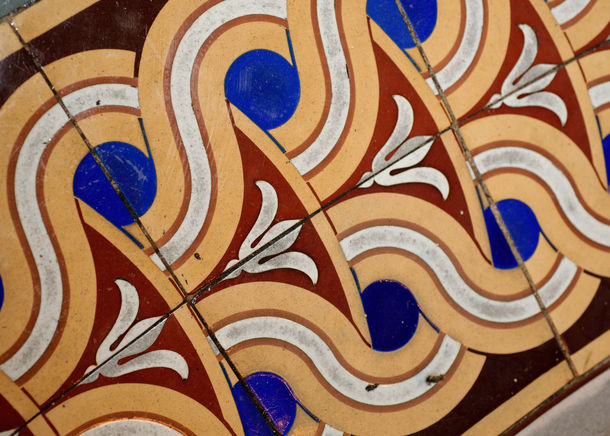
Colorful, richly patterned tiles crafted in England by Minton, Hollins & Company ornament the floors throughout much of the Senate wing of the U.S. Capitol. Chosen for their beauty and durability, Minton tiles, as they were commonly known, were installed between 1855 and 1859 as part of a major mid-19th-century expansion of the building. Architect of the Capitol Thomas U. Walter and supervising engineer Montgomery C. Meigs set out to find flooring material for the Capitol extensions that was attractive but also durable enough for use in the building’s high-traffic areas. Meigs, in particular, sought something more decorative and reflective of contemporary Victorian tastes than the comparatively austere bricks and stone pavers used in the older part of the Capitol (completed in 1826). The intricate designs of Minton’s inlaid encaustic tiles—formed by a specialized manufacturing process in which colored clays were embedded approximately one-eighth-inch deep in a one-inch clay base before firing—proved not only refined but also able to withstand significant wear. The tiles originally had a matte finish, though today they appear glossy due to the products used in current maintenance protocols.


Thomas Minton founded Minton & Company in Stoke-upon-Trent in Staffordshire, England, in 1793. Minton originally produced bone china and pottery. After the founder’s death in 1836, his son Herbert took control of the business and partnered with his nephew-in-law Michael Daintry Hollins in the early 1840s. Minton and Hollins soon expanded into different areas of production, most notably encaustic tiles. The company gained worldwide recognition for their innovative production methods and the superiority of their designs, winning medals at the 1851 Crystal Palace Exhibition in London and the 1855 Exposition Universelle in Paris.
Meigs reportedly knew of Minton tiles through advertisements published in English architectural journals, and he wrote to the company on September 14, 1854, requesting price and sample books, noting, “The examples of your tiles which I have seen in this country are confined to the smaller size & plainer figures. . . . I am desirous of obtaining the best floors that can be made.”1 Soon thereafter the New York City firm Miller, Coates & Youle (later Miller & Coates), which served as agents for Minton, Hollins & Company in the United States, sent samples of Minton tile to Meigs for review. Meigs worked directly with them to select designs for specific rooms and corridors in the extensions. Minton, Hollins & Company packed the approved tiles in wooden casks at the manufacturing facility and shipped them from Liverpool to New York City. From there, they traveled via rail to Washington, where skilled laborers hired by Miller & Coates installed them in the Capitol.
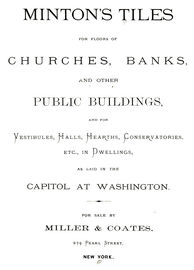
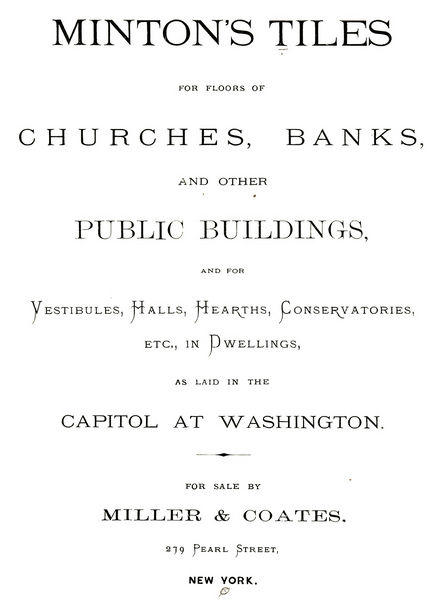
After the installation was complete, Miller & Coates used the selection of Minton tiles for the flooring in the Capitol extensions as a selling point for their business. As can be seen on the frontispiece of this pattern book, Miller & Coates emphasized that Minton tiles were “laid in the Capitol at Washington.” During the 1870s and 1880s, Minton tiles were selected for the flooring in other prominent civic and government buildings in the city, including the Smithsonian Institution’s Arts and Industries Building and the State, War, and Navy Building (today the Eisenhower Executive Office Building).
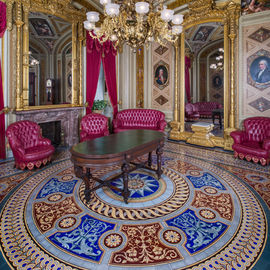
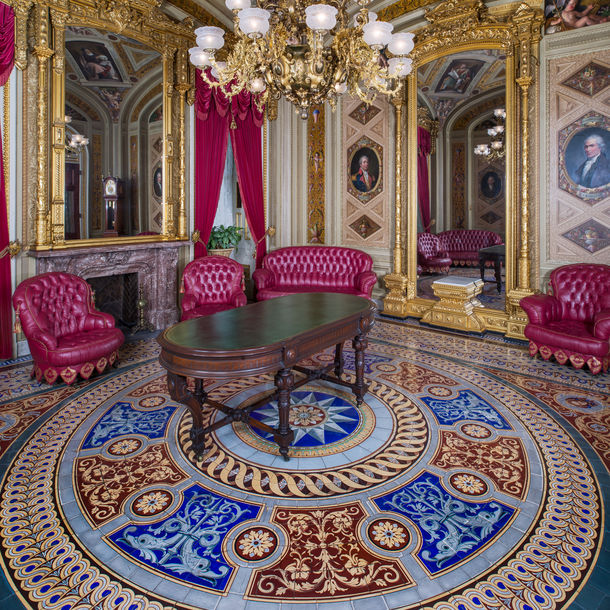
The tiles in the Capitol show a stunning array of colors and hundreds of different patterns. Colors found in the Capitol include buff, red, chocolate, white, black, light blue, cobalt blue, blue-gray, light green, dark green, bright pink, and purple. Their designs are just as varied, portraying figures such as dolphins, classical heads, cherubs, and cornucopias, as well as diverse architectural and floral patterns including Greek key, basket weave, guilloche, and fleur-de-lis. The layouts for highly decorated rooms and committee spaces feature elaborate centerpieces surrounded by fields of color and graphic borders that resemble the composition of large woven rugs. Indeed, during the winter months, the tile floors in most offices were covered with actual carpets that were then removed during the warmer seasons, once again revealing the Minton tile flooring. Meigs was apparently dismayed by this practice, writing in his journal in December 1858 that he hoped “all of the committees and officers in the Senate” could be “induced to give up the idea of putting a carpet upon the floor” of their spaces. He added, “It is too bad to have the beautiful tile floors, in patterns carefully designed for this building, covered with carpets.”2 Photographs that show carpets covering the Minton tile flooring—as well as Senate expenditure records—indicate that Meigs’s hopes were never fully realized.
U.S. Senate Collection | About this artifact
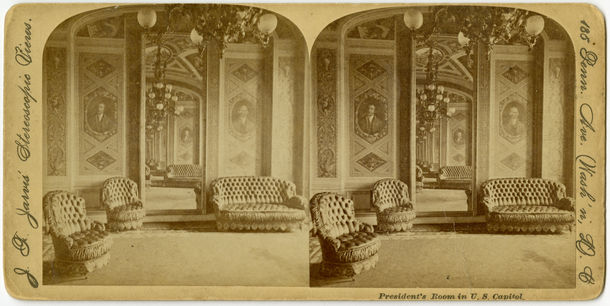
By the early 20th century, after decades of use, some of the Minton tiles in the House and Senate wings had become worn down. To address this wear, the Architect of the Capitol completely replaced the tile flooring in the House Lobby and in the first- and second-floor corridors of the House wing with marble by 1924. However, a desire to keep the original Minton tile flooring in other parts of the Capitol initiated research into alternative solutions. By the 1970s, H & R Johnson Company of Stoke-on-Trent—the successor to Minton, Hollins & Company, which retained some of its predecessor’s 19th-century records and equipment—was willing to revive the encaustic production process. After years of experimentation and negotiation, H & R Johnson Company reproduced many of the patterns of the original Minton tiles in the Capitol. The Architect of the Capitol began swapping highly worn tiles with new ones on a very limited basis in 1987–1988.
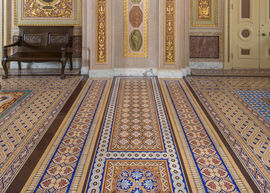
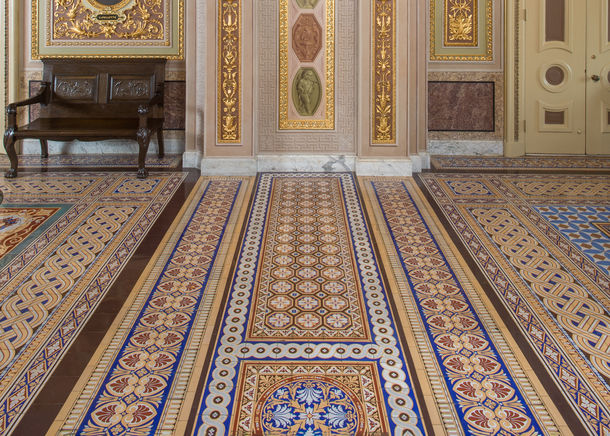
Though there have been occasional replacements and repairs of damaged tiles that present a safety hazard, most of the 1850s Minton tile flooring on the Senate side of the Capitol remains in place. The Senate Sergeant at Arms is responsible for the routine care of the tiles, including regularly cleaning, restoring, and burnishing them and, once or twice a year, stripping and waxing them. This frequent attention has helped ensure their longevity. For nearly 170 years, they have remained among the most distinctive and beloved architectural features of the Senate wing, appreciated by the millions of people who tread on them each year.
Notes
1. Montgomery C. Meigs, journal entry for September 14, 1854, published in Capitol Builder: The Shorthand Journals of Montgomery C. Meigs, 1853–1859, 1861, ed. Wendy Wolff (Washington, D.C.: U.S. Government Printing Office, 2001), 89; and William C. Allen, History of the United States Capitol: A Chronicle of Design, Construction, and Politics (Washington, D.C.: U.S. Government Printing Office, 2001), 241.