
The President’s Room | Murals
The artist Constantino Brumidi completed the elaborate murals that adorn the walls and ceiling of the President’s Room in 1859–1860. The murals were one of the key features that prompted early guidebooks to refer to the President’s Room as “one of the gems of the Capitol.”1 In the 1870s, diarist Mary Clemmer Ames described their effect as visually stimulating, even overwhelming: “Gilding, frescoes, arabesques, glitter and glow above and around. There is not one quiet hue on which the tired sight may rest. Gazing, I feel an indescribable desire to pluck a few of Signor Brumidi’s red legged babies and pug-nosed cupids from the precarious perches on the lofty ceilings.”2
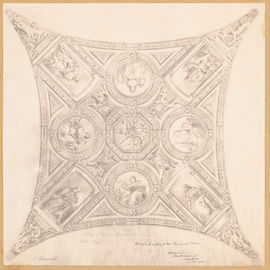
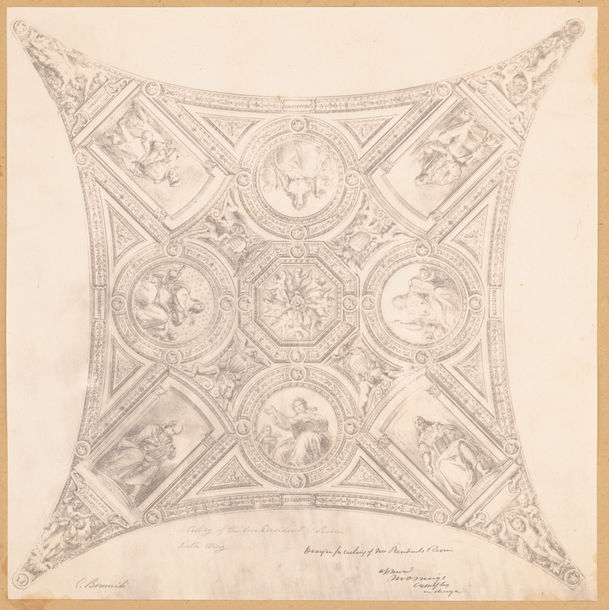
Brumidi, originally from Rome, based his design for these murals on the famed frescoes of the Stanza della Segnatura in the Vatican Palace, painted by Raphael between 1508 and 1511. As seen in a signed but undated drawing, Brumidi drew inspiration from Raphael’s composition for the ceiling by featuring four female allegorical figures in circular frames with four corner figures pictured in illusionistic niches and an octagonal shape filled with cherubs at the center. The four corner figures—portraits of Christopher Columbus, Amerigo Vespucci, William Brewster, and Benjamin Franklin—are visible in this drawing, indicating that they were part of the early plans for the room. The concepts illustrated by the four allegorical figures, however, changed between Brumidi's original design and the room’s final execution. The drawing, labeled “Ceiling of the Vice President’s Room,” suggests that the room's intended use changed while Brumidi was working on the design, perhaps contributing to the shift in subjects.
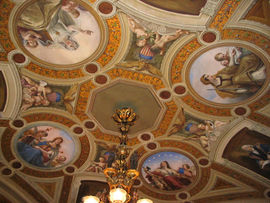
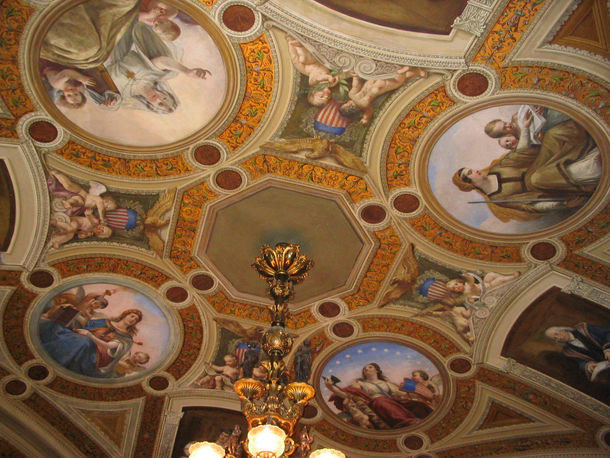
Whereas the four allegorical figures depicted in Brumidi’s drawing (Philosophy, Cosmology, Eloquence, and Religion) suggest sources of truth and understanding, the final allegories selected for the President’s Room personify the foundations of government. Executive [Authority] holds a scepter in her left hand while clutching books titled US Law and Philosophy in her right hand. A cherub to the left of her holds a torch of knowledge. Legislation holds a sword in her right hand and places her other hand on the Constitution. Liberty, wearing a red liberty cap, pulls an axe out of the fasces below an arch of 13 stars. Religion (the only concept remaining from Brumidi’s earlier plan), wears a transparent veil over her face and a cross around her neck. Pairs of cherubs with a red, white, and blue shield topped with a gold eagle appear between these figures.
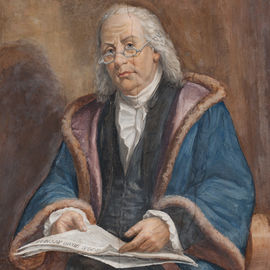
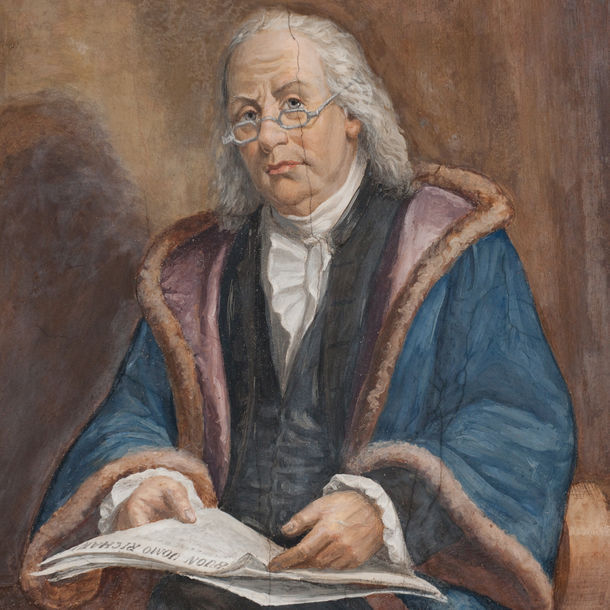
Thirty-six trompe l’oeil copper-relief medallions interspersed throughout the design feature seals of the states and territories at the time the mural was completed (1860); the medallions are arranged chronologically with the first states to enter the Union closest to the center of the dome and the territories placed along the outer edges. Additional cherubs occupy the pendentives below the portraits of Columbus, Vespucci, Brewster, and Franklin. The cherubs in the northeast corner of the room (under the portrait of Columbus) were created in true fresco in 1931 by artist Eben F. Comins to replace original cherubs by Brumidi that were badly damaged by leaks.
A bust-length portrait of George Washington, surrounded by an illusionistic octagonal gilded frame, appears below the figure of Liberty in the center of the large lunette that spans the south wall. The portrait is modeled on Rembrandt Peale’s 1824 portrait of Washington that is in the Senate Collection and was, at the time Brumidi was working on the President’s Room murals, hanging in the Vice President’s Room nearby. Allegorical figures of Peace (holding a laurel wreath and seated beside a cornucopia) and Victory (clutching a trumpet and a shield bearing the names of five significant Revolutionary War battles) flank Washington on both sides. Bust-length portraits of members of Washington’s first cabinet embellish the walls below. Secretary of State Thomas Jefferson is featured directly below Washington. Attorney General Edmund Randolph and Postmaster General Samuel Osgood appear on either side of the large mirror on the west wall. Secretary of War Henry Knox and Secretary of the Treasury Alexander Hamilton are portrayed on either side of the large mirror on the east wall.
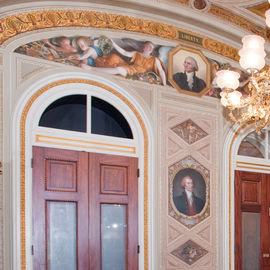
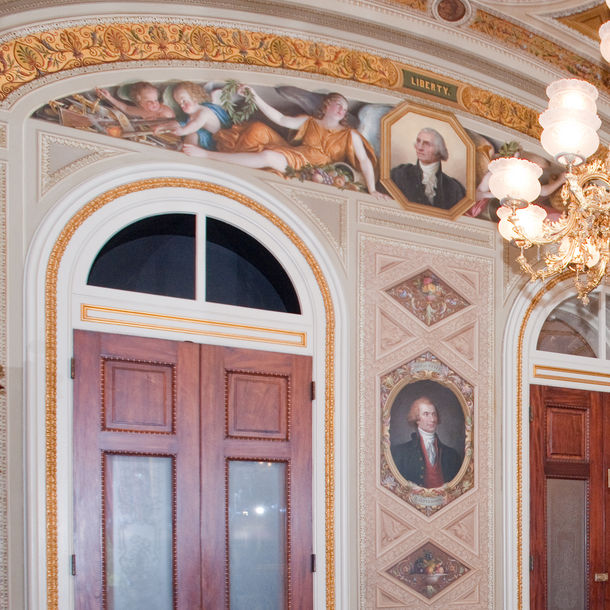
Painted illusionistic moldings and still lifes of fruit embellish the walls around these portraits. Bands of trellis-like arabesques intertwined around depictions of cherubs, patriotic shields, and classical heads follow the architectural lines of the room. Brumidi originally frescoed three cherubs with an American flag in the octagonal space at the center of the dome ceiling, such that the cherubs appeared to fly around the chandelier. However, the plaster around the fixture failed and fell to the floor in 1921, destroying this portion of Brumidi’s design.
By the late 20th century, the wall and ceiling murals had darkened significantly due to overpainting and the yellowing of varnish over the murals. A major professional conservation effort from 1994 to 1995 uncovered the original vibrant colors of the murals and revealed Brumidi’s fine technique.
Notes
1. John B. Ellis, The Sights and Secrets of the National Capital: A Work Descriptive of Washington City in All Its Various Phases (New York: United States Publishing Company, 1869), 89.
2. Mary Clemmer Ames, Ten Years in Washington: Life and Scenes in the National Capital, as a Woman Sees Them (Hartford, CT: A.D. Worthington & Co., 1873), 95.