Skip to main content
Murals
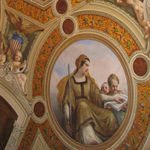
The artist Constantino Brumidi completed the elaborate murals that adorn the walls and ceiling of the President’s Room in 1859–1860. Brumidi, originally from Rome, based his design for these murals on the famed frescoes of the Stanza della Segnatura in the Vatican Palace, painted by Raphael between 1508 to 1511.
The President’s Room dome ceiling features representations of four allegorical figures in circular frames—Religion, Legislation, Liberty, and Executive [Authority]. Pairs of cherubs with a red, white, and blue shield topped with a gold eagle appear between them. Thirty-six trompe l’oeil copper-relief medallions interspersed throughout the design feature seals of the states and territories at the time the mural was completed (1860). In the corners below the cherubs are portraits of Christopher Columbus, Amerigo Vespucci, William Brewster, and Benjamin Franklin.
More about the President’s Room murals
Chandelier
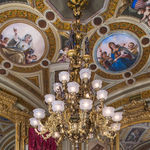
The President’s Room chandelier is the only light fixture specifically made for the Senate extension that remains in place. The Senate purchased it from the Philadelphia manufacturer Cornelius & Baker and installed it in the President’s Room in December 1863. Originally gas-burning, it was converted to electricity in 1896. The Washington, D.C.-based light-fixture company E. F. Brooks significantly enlarged the chandelier in 1915 by adding six new arms, seven lamps that project light upward from a central bowl, and numerous crystal prisms, which were later removed.
Today, the chandelier has 18 arms arranged in 3 tiers and is richly decorated with 15 cast-metal statuettes mingled with scrolls, foliage, and shells. The statuettes portray historical personages (Benjamin Franklin, Simon Kenton, and George Washington), allegorical figures (America and Prudence), and miscellaneous other character “types” (a hunter, a fisher, a Highlander, a Chinese juggler, cherubs, musicians, and dancers).
Mirrors & Cornices
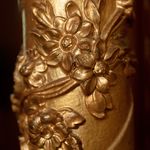
The three Renaissance Revival “ornamental gold gilt” mirror frames and two window cornices in the President’s Room have been in place since November 1886, when the Senate acquired them from John S. Willard. Willard provided many elaborate mirror frames for the Capitol during the 1880s, as well as the gilded base for the President’s Room clock. The mantel mirror on the north wall attaches to two cornices over the room’s windows, and the mirrors centered on the east and west walls have bases with small marble-top display surfaces.
Surviving correspondence indicates that Willard provided design drawings for the mirror frames as early as March 1883. These replaced the room’s previous mirror frames and cornices, which were simpler in design, as can be seen in early photographs of the President’s Room. Mirrors had always been an important element in the room’s overall scheme. A letter dated December 28, 1859, from the Superintendent of the Capitol Extension William B. Franklin to New York plate-glass manufacturers Noel & Saurel document payment for “three looking glass plates” to enhance the space. Francis Lamb, a local woodworking craftsman, reportedly designed the mirror frames and installed them in July 1860. Lamb also received payment in December 1866 for providing two large gilt cornices for the room.
Historic Furnishings
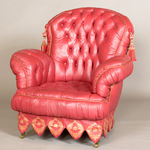
Most of the furnishings in the President’s Room have long been associated with this historic chamber. The set of two “Turkish”-style sofas, three armchairs, and two side chairs was acquired in 1875. In 1991–1992, the Senate Commission on Art restored these furnishings to their original appearance and reupholstered them in rich red Morocco leather. A large ornately carved American black walnut table was acquired for the room in 1877 and remains in place today.
Mid-19th-century photographs, as well as published property inventories from the early 1870s, reveal that the room’s previous furniture included eight Rococo-Revival style chairs and two Rococo-Revival style sofas upholstered in silk damask, as well as a marble-top table.
Clock
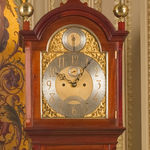
The Senate acquired this stately mahogany floor clock for the President’s Room in 1887 from the Washington, D.C.-based jewelers Harris & Shaefer. The clock stands on a custom gilded base topped with marble, which the Senate purchased the same year from John S. Willard (who also created the President’s Room’s three gilded mirrors). Photographs of the President’s Room dating from the late 1890s show the floor clock in the southeast corner of the room, the location where it stands today. Office of Senate Curator staff manually wind the clock weekly to ensure it keeps accurate time.
Minton Tiles
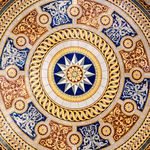
Colorful, richly patterned tiles crafted in England by Minton, Hollins & Company ornament the President’s Room floor. Chosen for their beauty and durability, Minton tiles were installed throughout much of the Senate wing between 1855 and 1859 as part of a major mid-19th-century expansion of the U.S. Capitol. The inlaid encaustic tiles’ intricate designs were formed by embedding colored clays into the tiles before firing, a process that yields a product both refined and able to withstand significant wear.
The design of the President’s Room flooring features a central star surrounded by concentric bands with various decorative motifs—including a double coil near the center, stylized dolphins and foliage in the middle, and a double guilloche at the outer edge—that complete the medallion.
More about Minton tiles
Foreign Gifts
A rotating display of gifts received by senators and Senate employees from foreign governments has been on view in the President’s Room since 1994. These gifts, whose use and acceptance are governed by the policies and procedures outlined in the Foreign Gifts and Decorations Act, 5 U.S.C. § 7342, record the significance of gift-giving in modern-day international relations.
Foreign gifts in the Senate Collection