

Senate Stories | Charles Dominique Bouligny: First Hispanic Senator

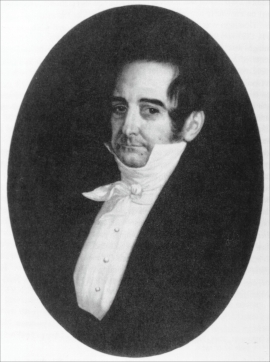
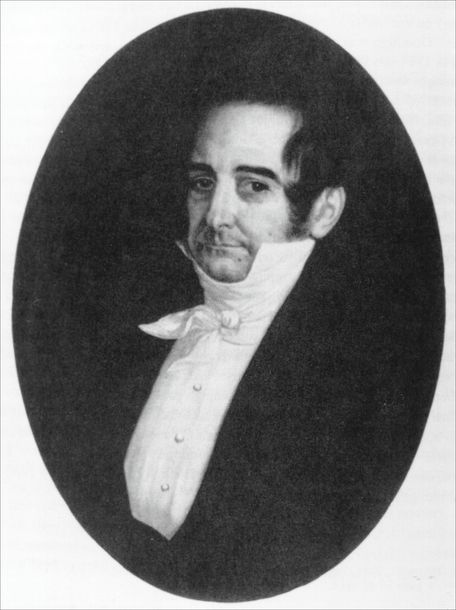
For decades, congressional historians have recognized Octaviano Larrazolo of New Mexico as the first Hispanic American to serve in the U.S. Senate. Historians often revisit long-standing narratives and consider new evidence. A recent re-examination of available sources by Senate historians complicates this long-standing account. More than a century before Larrazolo’s election in 1928, Louisiana elected Charles Dominique Bouligny to a vacant Senate seat. Bouligny was born a Spanish citizen in New Orleans in 1773 when the Crescent City was part of Spain’s North American empire, making him the first Hispanic senator. During his five years of Senate service, from 1824 to 1829, Bouligny worked to protect the interests of Louisiana’s slaveholders and sugar industry.1
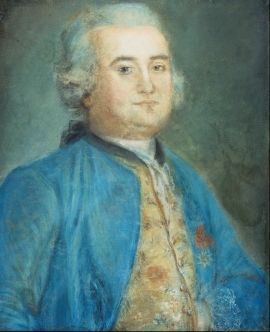
The Historic New Orleans Collection
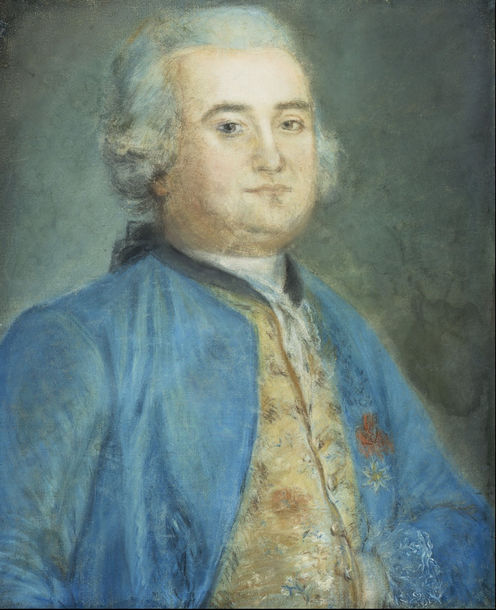
Charles Dominique Bouligny (who went by Dominique) was the second child and first son of Francisco Bouligny and Marie Louise Le Sénéchal D’Auberville. Born in Spain, Francisco had trained in the Royal Regiment of Spanish Guards before being assigned to Havana, Cuba, and later stationed in New Orleans. Bouligny’s mother, Marie Louise, was born in New Orleans to a wealthy French political family and brought a considerable dowry, including property, to the union.2
Francisco Bouligny played a prominent role in Spain’s newly established North American empire. He promoted Spanish settlements and commerce. Fluent in French and Spanish, he negotiated the peaceful transfer of New Orleans to Spanish possession in 1769, earning him a military promotion and appointment in the new Louisiana Battalion. He helped to protect Spanish settlements from encroachment by other colonial powers and led successful military expeditions against British settlements in West Florida. In 1777 Francisco Bouligny was named lieutenant governor of the territory and promoted to brevet lieutenant colonel.3
Dominique grew up on his parents’ sugarcane plantation along the Mississippi River and in a second residence they owned in the city. When he was 12 years old, his father appointed him as a cadet in the Spanish military, launching a long and successful military career. In part as recognition for his service, territorial governors provided Dominique with two separate land grants, one in 1796 and a second in 1798. He became the head of the household when Francisco died in 1800, and soon after, he began to chart his political fortunes. Using family connections, he purchased membership in the cabildo, the political governing body of New Orleans in which positions were then bought and sold. In 1803 Dominique married Doña Anna Le Blanc, a wealthy orphan living as her uncle’s ward, and they had 15 children. At the time of their marriage, the Boulignys managed extensive properties, including sugarcane plantations and the enslaved people who worked them.4
Just as the couple embarked upon a new life together, the world they had known changed dramatically. In 1800 Spain had quietly agreed to transfer Louisiana, and New Orleans, to France. And, in April 1803, the United States purchased the Louisiana Territory from France. The Senate finalized the Louisiana Purchase six months later in October. When the cabildo met on June 4, 1804, those loyal to the Spanish crown were encouraged to relocate to other parts of the Spanish empire, including Mexico. Bouligny chose to remain in New Orleans, retiring as a lieutenant in Spain’s Louisiana Fixed Regiment.5

National Archives and Records Administration

Over the next few years, Bouligny navigated the political, social, and economic shifts that accompanied the territory’s transition to American control. The terms of the Louisiana Purchase Treaty conferred citizenship to all the territory’s inhabitants. Now an American, Bouligny entered elective politics, winning a seat in the territorial house where he served from 1805 to 1809. During his tenure, he helped to develop the territory’s judicial system.6
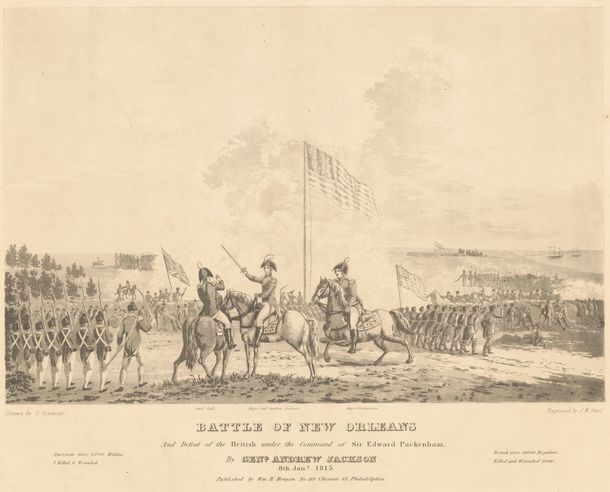
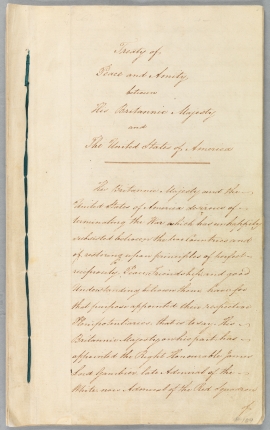
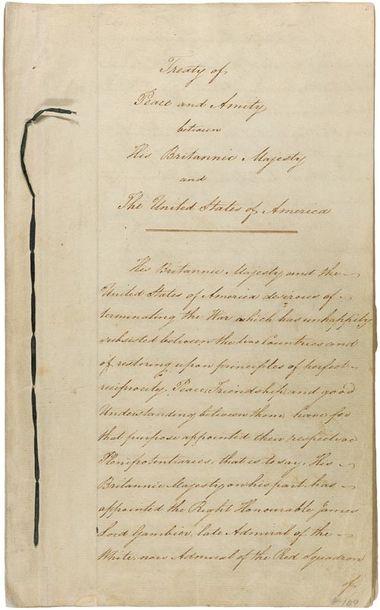
On April 30, 1812, Congress admitted Louisiana to the Union as the 18th state. Less than two months later, on June 17, Congress declared war with Britain. The French Revolution of 1789 had sparked ongoing conflict between France, Great Britain, and other European powers, and although the United States had maintained a careful neutrality, continuing to trade with belligerents, Congress ultimately declared war after the British Navy began stopping and searching American merchant ships for deserters, seizing American property, and impressing American sailors into British service. The city of New Orleans, situated at the mouth of the Mississippi River, became a principal target of British forces. In 1814 city officials appointed Bouligny to the committee on public defense, which organized volunteer forces in the region. These volunteers assisted in the campaign of Major General Andrew Jackson, whose defeat of the British at the Battle of New Orleans on January 8, 1815, marked the end of local hostilities. The Senate approved the Treaty of Ghent unanimously on February 16, 1815, formally ending hostilities.7
Library of Congress
After the war, Bouligny continued to manage his sugarcane plantation and other investments even while he accepted appointment in 1819 to a committee to review the personal archive of Carlos Trudeau, the Spanish royal surveyor from 1786 until 1805. The state of Louisiana had purchased the unique collection of land surveys and ownership records to help resolve disputed land claims. Perhaps because of his prominence in the community, and a lifetime in public service, on November 19, 1824, the Louisiana legislature elected Bouligny to fill a vacant U.S. Senate seat following the resignation of Henry Johnson.8
Bouligny took the oath of office on December 21, 1824. Later that day, he voted for a bill to provide a gift of money and land to the Marquis de Lafayette, hero of the American Revolution who had fought alongside General George Washington. This gesture served as an expression of Congress’s gratitude for Lafayette’s help to secure American independence and coincided with Lafayette’s visit to commemorate the approaching 50th anniversary of the Revolution. Two weeks after the vote, Bouligny was named to the Joint Committee on General Lafayette, which presented a letter to the war hero explaining that the gift was to “reimburse a portion” of what “your long and arduous devotion to the cause of freedom has cost you.”9
Bouligny joined the Senate during a time of bitter factional disputes. Just weeks before his swearing in, the 1824 presidential election between Andrew Jackson, John Quincy Adams, Henry Clay, William Crawford, and John C. Calhoun had failed to produce a clear winner. Jackson won a plurality but not a majority of the popular and electoral votes. When the election moved to the U.S. House of Representatives in early 1825, lawmakers elected Adams as president. Adams later nominated Clay as U.S. secretary of state, causing his opponents to accuse Adams and Clay of engaging in a “corrupt bargain” to secure Adams’s selection. Bouligny aligned himself with the Adams-Clay Republicans, voting to confirm Clay as secretary of state when his nomination went before the Senate in March 1825.10
National Archives and Records Administration
In the Senate, Bouligny helped to protect the interests of Louisiana slaveholders. In January 1825, he introduced a bill to permit a woman named Anna Dubord to bring into Louisiana 13 enslaved people she had previously brought to Cuba in 1819. The private bill, which did not become law, would have allowed Dubord to legally import slaves from a foreign country, which Congress had outlawed with the Slave Trade Act of 1807. In 1828 he joined with Georgia Senator John E. Frost to request the extension of a commission to review claims made under the terms of the Treaty of Ghent. Claimants whose property had been seized by the British after the treaty’s ratification could petition for compensation for their losses. In backing the measure, Bouligny was serving the interests of Louisiana enslavers who sought compensation for human property “carried off” from American vessels by the British. Congress did extend the term of the commission, though it remains unclear if Bouligny’s constituents’ claims were approved for payment.11
Congressional debates in 1828 over a controversial tariff bill dominated Bouligny’s final year in the Senate. The battle began when the Adams administration presented a tariff bill to Congress that sharply raised import duties on certain products by as much as 50 percent to protect domestic industries in the Northeast, Mid-Atlantic, and Western regions from overseas competition. Southern planters who depended on trade with Great Britain, however, roundly opposed the measure and worried it would lead to retaliatory tariffs on American goods. They labeled it “The Tariff of Abominations.” Hoping to limit Adams’s re-election potential that fall, Jackson supporters in Congress, led by Senator Martin Van Buren of New York, worked to “neutralize” provisions in the bill that they worried would help Adams’s electoral chances. The bill that emerged from the amendment process was designed to deliver support to Jackson at the expense of Adams’s New England by raising duties on imported raw materials needed by northeastern manufacturers.12
U.S. Senate Historical Office
On May 13, 1828, Bouligny was the only Southern senator to vote for the tariff. Back home, major sugar interests in Louisiana largely supported high tariffs and the protection import fees provided from competition from Cuban sugar. In Washington, however, the Tariff of 1828 provoked harsh recriminations between regional factions in Congress. As the tariff issue roiled the 1828 presidential election—as well as Bouligny’s re-election chances—Jackson swept the South. On January 12, 1829, the Louisiana legislature elected Edward Livingston, a Jackson ally who had opposed the tariff while serving in the House, to replace Bouligny in the Senate.13
Bouligny cast one of his final Senate votes in defense of Congress’s constitutional prerogative to control federal spending, the so-called “power of the purse.” The Adams administration presented Congress with a request for appropriations to support an exploratory mission to the Pacific Ocean and South Seas. The Senate had previously defeated a bill to provide the funds, while the House had approved it with carefully defined stipulations. The administration had begun to outfit naval vessels for the expedition, incurring expenses in the process without Congress’s express approval. When the Senate took up a new bill to fulfill Adams’s request, a frustrated Senator Robert Hayne of South Carolina objected that it retroactively authorized the administration’s spending despite lawmakers having already set clear parameters. The Senate ultimately blocked the bill, with Bouligny joining in that effort.14
After his Senate service concluded on March 3, 1829, Bouligny returned to Louisiana and retreated to private life. He died on March 5, 1833, at the age of 60. Today, after long overlooking his heritage, Senate historians recognize Charles Dominique Bouligny as the Senate’s first Hispanic member.15
Notes
12. Robert V. Remini, Henry Clay: Statesman for the Union (New York: W.W. Norton & Co., 1991), 329–30; Daniel Walker Howe, What Hath God Wrought: The Transformation of America, 1815–1848 (New York: Oxford University Press, 2007), 273–5; Robert V. Remini, Martin Van Buren and the Making of the Democratic Party (New York: Columbia University Press, 1951), 183.
13. Howe, 273; Joel Sturgeon, “Edward Livingston, Nullification, and Louisiana’s Political Transformation,” Journal of the Early Republic 43 (Fall 2023), 455–89; Govtrack.us, "Roll Call Vote 140 on May 13, 1828, 'To Pass Tariff Bill,'" https://www.govtrack.us/congress/votes/20-1/s140, accessed September 30, 2026; Official Journal of the Senate of the State of Louisiana, 9th legislature, 1st sess., January 12, 1829, 50–51, https://digitalcollections.crl.edu/record/302306?ln=en&v=uv#?xywh=55%2C37%2C1116%2C756&cv=41, accessed September 30, 2026.