
States in the Senate | Wisconsin Timeline
1848
May 29
Wisconsin was admitted as the 30th state in the Union.
1848

June 8
Henry Dodge, born in Vincennes, Indiana but later of Dodgeville, Wisconsin, and Isaac P. Walker, born near present day Wheeling, West Virginia, but later of Milwaukee, were elected Wisconsin's first United States senators.
1848

June 23
The oath of office prescribed by law was administered to Henry Dodge and he took his seat in the Senate. Dodge was the father of Senator Augustus Caesar Dodge of Iowa, who took office in December, and the father and son served together until Augustus’s resignation in 1855. They're the only parent and child to have served simultaneously in the Senate.
1848

June 26
Isaac P. Walker took his seat in the Senate, after which Walker and Henry Dodge drew lots to determine their Senate class assignments. Walker drew Class 3 (to expire in 1849) while Dodge drew Class 1 (to expire in 1851).
1856
June 16
Senator Henry Dodge became chairman of the Committee on Commerce (today's Committee on Commerce, Science, and Transportation), serving until 1857.
1856
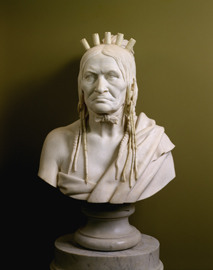
A bust of Ojibwa or Chippewa leader Be sheekee (“Buffalo”), carved by Francis Vincenti, was “[p]urchased by the United States government with funds appropriated for the extension of the United States Capitol.” Be sheekee was chief of the La Pointe band of Ojibwa, and traveled to Washington, D.C., in 1852 and 1855 to discuss and sign treaties.
1861

July 6
Senator James R. Doolittle, born in Hampton, New York, but later of Racine, became chairman of the Committee on Indian Affairs, serving until 1866.
1873

March 12
The Senate elected Matthew H. Carpenter as its president pro tempore, a position to which he was elected again on three occasions. Born in Moretown, Vermont, but later of Milwaukee, Carpenter was described by one reporter as “the best speaker in the Senate at the present time.” Carpenter was an unsuccessful candidate for reelection in 1875 but served again in 1879 as Wisconsin’s Class 3 senator and died in office on February 24, 1881.
1893

March 4
John L. Mitchell of Milwaukee became Wisconsin’s first native-born United States senator.
1896
April 29
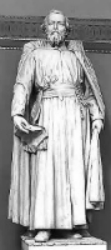
The Senate moved to accept a marble statue of French Jesuit missionary and explorer Jacques Marquette by Gaetano Trentanove for placement in National Statuary Hall. Because Marquette died before Wisconsin’s admission to the Union and he therefore never resided in the state, a joint resolution of Congress in April 1893 allowed his commemoration him in Statuary Hall .
1899
December 15
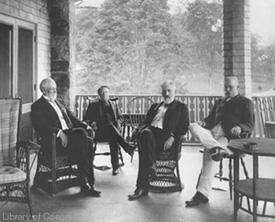
Senator John C. Spooner became chair of the Committee on Rules (today's Committee on Rules and Administration), serving until 1907. Spooner had previously served one term in the Senate (1885–1891) but was an unsuccessful candidate for reelection. He returned to the Senate in 1897 and became one of the powerful “Senate Four”—along with Senators Orville H. Platt of New York, William B. Allison of Iowa, and Nelson W. Aldrich of Rhode Island—who dominated the Chamber’s deliberations.
1906
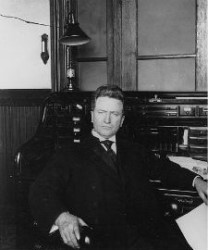
April 19
After just three months in office, Robert M. La Follette of Madison gave his maiden Senate speech which lasted eight hours over three days and covered 148 pages in the Congressional Record. As he began to speak, most of the senators present in the Chamber pointedly rose from their desks and departed. La Follette’s wife, observing from the gallery, wrote, “There was no mistaking that this was a polite form of hazing.”
1912

March 27
After an investigation into allegations of electoral misconduct involving bribery and corruption, the Senate voted that Isaac Stephenson retain his seat. Stephenson, born in Yorkton, Canada, but later of Marinette, was elected in 1907 at the age of 78 to fill the vacancy caused by resignation of Senator John C. Spooner and served until 1915.
1914
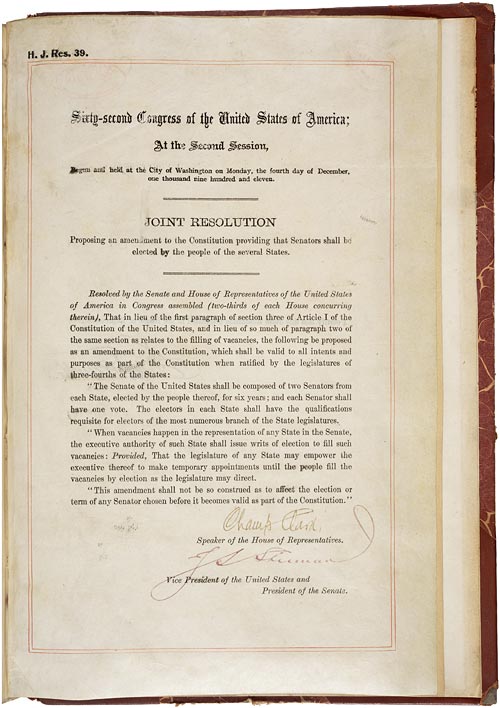
November 3
Paul O. Husting of Mayville became Wisconsin’s first directly elected United States senator following the adoption of the Seventeenth Amendment to the Constitution in 1913.
1917

October 6
In response to fierce criticism of his speech delivered the previous month, opposing American participation in World War I, Senator Robert M. La Follette delivered the most famous address of his 20-year Senate career—a classic defense of the right to free speech in times of war. La Follette’s earlier comments against the war had prompted a petition for his expulsion and a Senate investigation into his conduct.
1917

October 21
Senator Paul O. Husting was accidentally shot to death by his brother while duck hunting on Rush Lake, near Picketts, Wisconsin.
1921
March 5
Senator Robert M. La Follette became chairman of the Republican Order of Business Committee (precursor to the Republican Steering Committee), serving in that position until 1923.
1924

January 9
Senator Robert M. La Follette was denied the chairmanship of the Interstate Commerce Committee (today's Committee on Commerce, Science, and Transportation) by the Republican caucus, which instead elected the ranking Democrat, Senator Ellison D. Smith of South Carolina. La Follette’s role in the Progressive Party was cited as the reason.
1924
November 28
The Senate Republican caucus demoted Senator Robert M. La Follette from the chairmanship of the Committee on Manufactures, a committee he had chaired since 1919, to the next to the last place on that committee because of his support for the Progressive Party, a thorn in the side of the Republican Party. On March 9, 1925, the Senate voted 65 to 11 to accept the caucus decision.
1925

September 29
Robert Marion La Follette Jr. of Madison, was elected to fill the vacancy caused by death of his father, Senator Robert M. La Follette, in June. La Follette Jr. had served as his father’s private secretary for seven years and was sworn in at the age of 30 years, 10 months. Together, the father and son held Wisconsin’s Class 1 Senate seat for 42 years (1905–1947).
1929
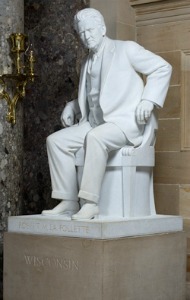
April 22
The Senate moved to accept a marble statue of the late senator Robert M. La Follette (1855-1925) by Jo Davidson for placement in Congress’s National Statuary Hall Collection.
1935
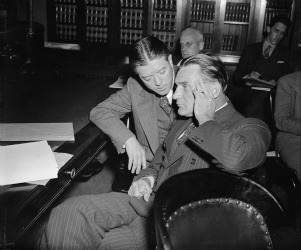
January 2
The Republican Committee on Committees decided that Robert Marion La Follette Jr. could retain his committee assignments despite leaving the GOP to form the Wisconsin Progressive Party in 1934.
1947
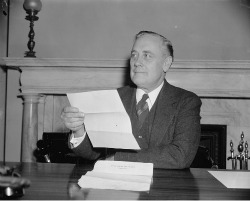
January 6
Senator Alexander Wiley of Chippewa Falls became chairman of the Committee on the Judiciary, serving until 1949.
1950

February 9
Senator Joseph R. McCarthy of Appleton first raised charges that Communists had infiltrated federal government agencies in a Lincoln Day speech delivered in Wheeling, West Virginia.
1950
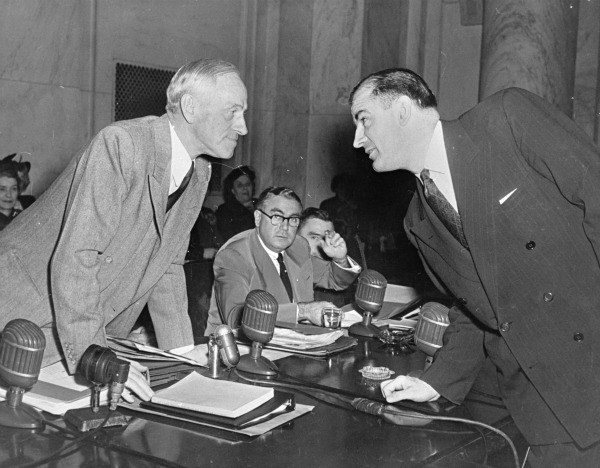
March 8
The Senate Committee on Foreign Relations began subcommittee hearings, chaired by Maryland senator Millard Tydings, to investigate charges by Senator Joseph R. McCarthy of alleged disloyalty by State Department employees. After investigating the charges, the committee rejected them as “a fraud and a hoax perpetrated on the Senate of the United States and the American people.”
1950

June 1
Maine senator Margaret Chase Smith delivered her “Declaration of Conscience” speech, attacking—without naming—Senator Joseph R. McCarthy for his anticommunist tactics of “vilification” and “smear.”
1953

January 13
Senator Alexander Wiley became chairman of the Committee on Foreign Relations, serving until 1955.
1953
January 13
Senator Joseph R. McCarthy became chairman of the Committee on Government Operations (today's Committee on Homeland Security and Governmental Affairs), serving until 1955.
1953
February 4
Former senator Robert Marion La Follette Jr. died from a self-inflicted gunshot at his home in Washington, D.C.
1953
February 13
The Permanent Subcommittee on Investigations of the Senate Committee on Government Operations, chaired by Senator Joseph R. McCarthy, began closed-door hearings into allegations of Communist influence within the Voice of America. In the following months, the subcommittee held public and closed-door hearings on similar allegations about the State Department, the overseas library program of the International Information Agency, the Government Printing Office, and finally, theU.S. Army. This led to the Army-McCarthy hearings in the spring of 1954, resulting from McCarthy's accusations of lax security at a top-secret army facility, and the army's charge that the senator had sought preferential treatment for a recently drafted subcommittee aide.
1954
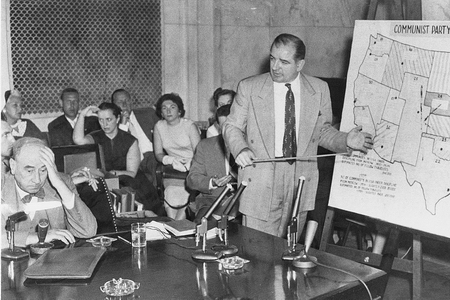
June 9
At a public session of the Army-McCarthy hearings, Senator Joseph R. McCarthy charged that one of the army’s attorneys had ties to a Communist organization. As an amazed television audience looked on, the army’s lead counsel, Boston lawyer Joseph Welch, responded with the immortal lines that ultimately ended McCarthy's career: "Let us not assassinate this lad further, senator. You have done enough. Have you no sense of decency, sir, at long last? Have you left no sense of decency?"
1954
December 2
The Senate voted 67 to 22 to condemn the conduct of Senator Joseph R. McCarthy for being "contrary to senatorial traditions" and for tending "to bring the Senate into honor and disrepute . . . and to impair its dignity." Senator Ralph E. Flanders of Vermont had introduced the resolution on July 31, 1954.
1957
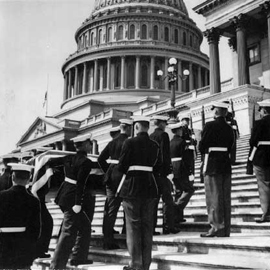
May 6
A funeral service for the late senator Joseph R. McCarthy was held in the Senate Chamber. McCarthy died while in office at the naval hospital in Bethesda, Maryland, on May 2, 1957.
1957
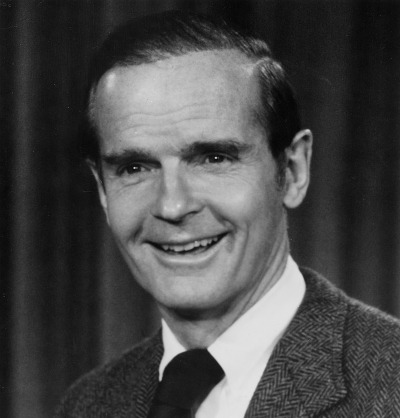
August 27
William Proxmire, born in Lake Forest, Illinois, but later of Madison, was elected to fill the Senate vacancy caused by the death of Senator Joseph R. McCarthy. Senator Proxmire was the first Democrat elected to the Senate from Wisconsin in 25 years.
1959
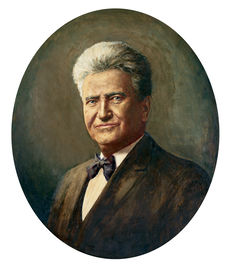
March 12
A portrait of Senator Robert M. La Follette (1855–1925) by Robert Chester La Follette, the son of the senator’s first cousin, William L. La Follette, was unveiled in the Senate Reception Room (S213). The work was one of five commissioned to commemorate former outstanding senators.
1962
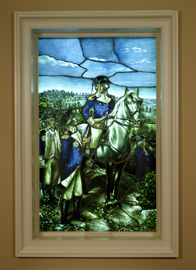
The George Washington Memorial Window by Wisconsin artist Maria Herndl was placed in the Senators' Dining Room (S109). The 6-by-3-foot stained glass window was purchased by the United States government in 1910.
1963

September 28
Over the course of two days, September 28th and 29th, Senator William Proxmire filibustered the public debt ceiling limitation for 16 hours and 12 minutes.
1970

April 22
The first official Earth Day celebration, initiated by Senator Gaylord Nelson of Madison, took place in cities and towns across the United States.
1975
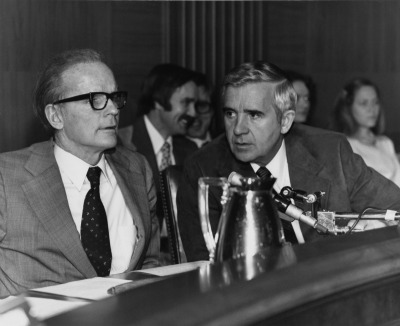
January 17
Senator William Proxmire became chairman of the Committee on Banking, Housing, and Urban Affairs, serving until 1981. Proxmire chaired the committee again from 1987 to 1989.
1984
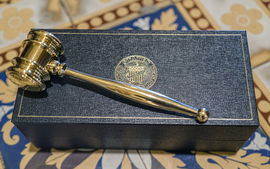
August 10
Senator Robert W. Kasten, Jr., of Milwaukee received the Golden Gavel Award for presiding over the Senate for at least 100 hours in a single session. Kasten received a second Golden Gavel in October 1986.
1989
January 3
Senator William Proxmire was not a candidate for reelection in 1988 and at the end of his fifth full term in office became Wisconsin’s longest-serving United States senator with 31 years, 4 months, and 6 days.
1990

November 13
Senator Robert W. Kasten Jr. was elected Republican Conference secretary for the 102nd Congress and served until 1993.
1995
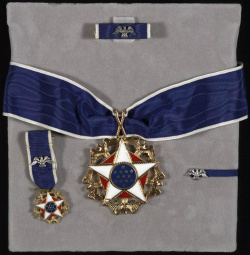
September 29
Former senator Gaylord A. Nelson was awarded the Presidential Medal of Freedom, given by the president of the United States to honor individuals who have made great contributions to either the United States or the world. To date, 30 senators have received the award.
2012

November 6
Tammy Baldwin of Madison became the first woman elected to represent Wisconsin in the United States Senate.
2013
October 4
Tammy Baldwin received the Golden Gavel Award for presiding over the Senate for at least 100 hours in a single session. Baldwin received a second Golden Gavel on December 15, 2014.
2015

January 8
Ron Johnson became chairman of the Senate Committee on Homeland Security and Governmental Affairs, a position he held until 2021.