

Senate Stories | The Value of Senators’ Records

John Sherman Papers, Manuscript Division, Library of Congress
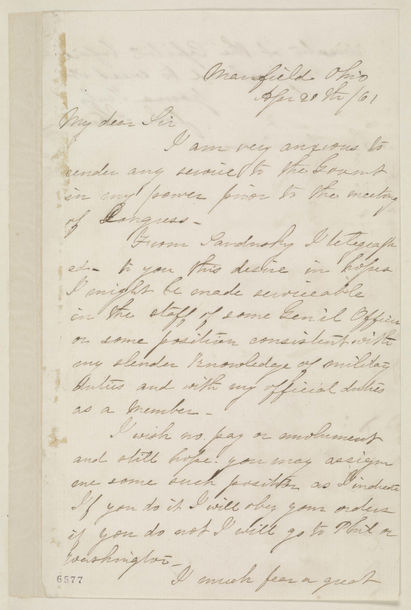
Senator John Sherman of Ohio had been in the Senate barely five days when it adjourned in late March 1861. Weeks later, Confederate forces fired on Fort Sumter, South Carolina. Congress wasn’t due back until July, but Sherman was eager to assist during a time of national crisis. In a letter to his governor, Sherman offered to serve in any military role the governor could find for him; no pay required. Fortunately for historians, this 19th-century letter has been preserved as part of Senator Sherman’s archival collection.1
Types of Senate Records
Telling the history of the U.S. Senate is like assembling a giant jigsaw puzzle. Each source, when placed alongside another, helps create a richer, more vibrant picture of this institution and its impact on our nation’s history. Historians rely upon the work of archivists, who have preserved a variety of sources, to develop that multifaceted picture.
Some sources are created as “official” Senate records. The Constitution requires that Congress document its proceedings. When conducting official business, the Senate produces the Congressional Record, a record of its proceedings, as well as legislative and executive journals and vote tally sheets. Senate committees generate additional official records when they hold hearings, review nominations and treaties, draft and amend bills and resolutions, and file reports. Under the law, Senate archivists transfer administrative, legislative, and committee records to the Center for Legislative Archives at the National Archives for preservation.
These official records document the institution’s collective actions. What about the individual contributions of the Senate’s members? Records created by a senator’s office to support their public duties include legislative drafts, constituent casework, staff memos, press and communications files, and correspondence. These collections, which include personal and official correspondence, capture the informal negotiations between senators and staff, document otherwise private debates, and provide a glimpse of the perspectives of ordinary citizens on issues of national import. Sources created by senators, such as Senator Sherman’s letter to the governor, complement official records and provide historians with a more nuanced picture of the Senate’s role in governing the nation. Though Congress was in recess when the Civil War broke out, and therefore not producing “official” records, Sherman’s letter serves as evidence that senators were nevertheless fully engaged in war-related activities.
U.S. Government Printing Office
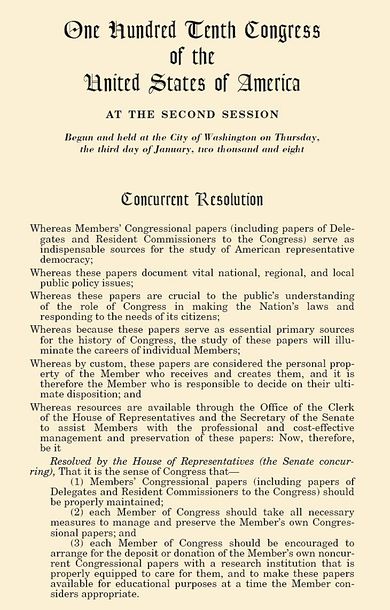
Senators’ records are the private property of each individual member, by custom and tradition. Unlike official Senate records, they have no automatic archival destination. When a senator or representative leaves office, these collections are theirs to keep, donate, or discard. In 2008 Congress passed H.Con.Res. 307, which expressed the “sense of Congress” that members should preserve their papers by entrusting them to “research institutions who can care for them,” such as a university library or research center, a historical society, or a state library. The resolution called these collections “primary sources” essential to the historical record and “indispensable . . . for the study of American representative democracy.” Though it carried no enforcement mechanism, only an expression of values, its language was striking in its conviction. Ultimately, each member decides how and where to archive their records.2
Legislating Off the Record
Most U.S. civics textbooks describe a straightforward process for how a bill becomes a law: a bill is introduced in Congress, debated in committee, voted on in the Senate and House, and signed into law. That version of events leaves a lot out. As one senator observed, “A lot goes on unseen on how we operate in this chamber.” Legislation today is often shaped by closed-door negotiations and informal conversations and folded into large omnibus packages, actions not documented by official records. Senators’ archival collections complement those official records, providing additional context for the laws that shape daily life.3
The Dirksen Congressional Center
The Civil Rights Act of 1964, which ended racial segregation in public and private facilities, offers a vivid example of how members’ records can complement official Senate sources, helping Senate historians to tell the complex story about this landmark legislation. The official record captures what happened on the Senate floor—the debates, the vote to secure cloture, and the eventual passage of the bill. Members’ personal collections provide evidence of their contributions during 60 days of Senate filibuster. Senate Majority Leader Mike Mansfield’s papers at the University of Montana, for example, illuminate his approach to leadership during this challenging period. His notes from a private meeting with Senator Richard Russell of Georgia—who led the opposition to the bill—reveal the back-channel conversations that shaped the floor fight.4
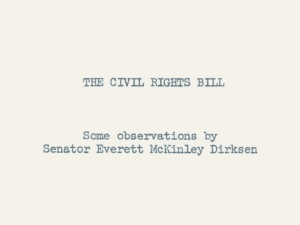
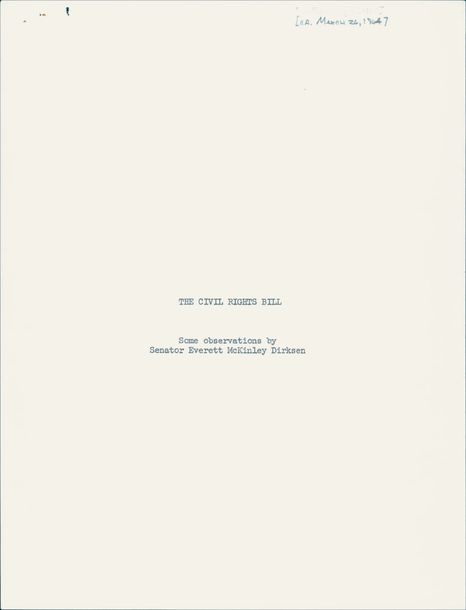
The archival collection of Senate Minority Leader Everett Dirksen of Illinois, whose support was essential to invoke cloture and end the filibuster, is equally informative. A March 1964 document, located at the Dirksen Congressional Center in Pekin, Illinois, illustrates Dirksen’s careful title-by-title analysis of the bill. An attorney by training, Dirksen raised legal concerns about the proposal and sketched proposed revisions. This document reflects the careful drafting work that made the bill’s passage possible. Two days after the Senate’s historic cloture vote on June 10, Roy Wilkins, the executive secretary of the National Association for the Advancement of Colored People, who had worked tirelessly to ensure the bill’s passage in the Senate, wrote to Dirksen. Wilkins expressed gratitude for Dirksen’s leadership in securing cloture on the bill and for recognizing the contributions of Black Americans to the nation in his final speech before that historic vote. Many critical details about the Senate’s passage of this landmark legislation are not recorded in official Senate sources, such as the Congressional Record. They can be found in members’ files.5
Letters from Citizens
From our nation’s earliest days, members of Congress have communicated with their constituents. A fascinating component of Senators’ archival collections are the letters, postcards, telegrams, and, more recently, emails, sent from constituents. These materials provide a barometer for public opinion on a wide range of issues. Researchers have used this correspondence to understand how Americans experienced the Great Depression of the 1930s, their thoughts about the civil rights movement and the Vietnam War, as well as their impressions of the Iran-Contra congressional hearings. These records provide the genuine, unfiltered sentiment of constituents responding to events in real time. They preserve the voices and opinions of those who rarely appear in history books.6
William E. Borah Papers, Manuscript Division, Library of Congress
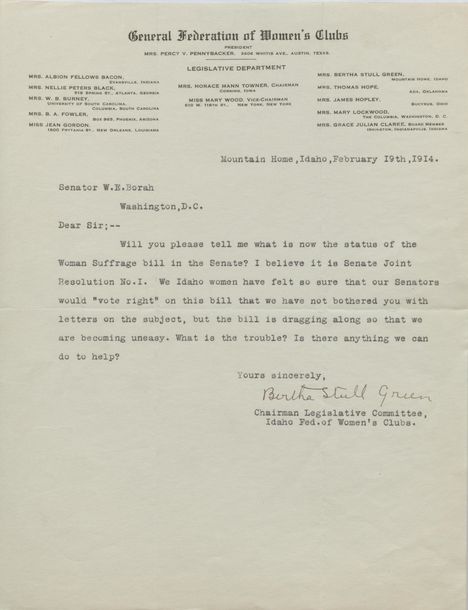
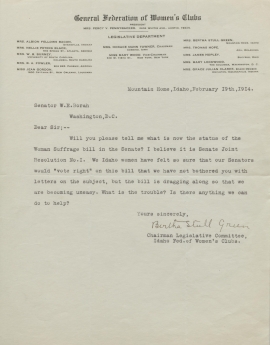
Bertha Stull Green is one of them. In 1914 she wrote to Senator William Borah of Idaho, on behalf of the General Federation of Women’s Clubs, expressing the support of Idaho women for a constitutional amendment to provide for women’s suffrage—what became the Nineteenth Amendment. Green was not famous. She held no public office. Her advocacy, and Borah’s detailed reply, survive for one reason: Borah’s papers, including hundreds of letters the senator had received while in office, were preserved. Letters like Green’s demonstrate that support for the Nineteenth Amendment was building years before it was approved by the Senate (1919) and ratified by the states (1920). Congressional collections contain snapshots of the variety of opinions held by people like Green at a given moment in time.7
Learning from Primary Sources
It’s not just researchers and historians who learn from senators’ records. Educators across the country utilize members’ collections to help students better understand our federal system and how it operates. A project using the papers of West Virginia Senator John D. Rockefeller IV, for example, housed at the West Virginia and Regional History Center, West Virginia University Libraries, allows undergraduate and graduate students to trace the development of the 1997 Children’s Health Insurance Program. Students can work with the original sources—memos, letters, and bill drafts—to reconstruct the legislative process, beginning with early staff conversations and concluding with the legislation’s final passage. At the University of Kentucky, political scientists and archivists developed teaching modules to highlight the Senate’s role in considering nominations to the U.S. Supreme Court. Senator John Sherman Cooper’s papers include a collection of correspondence from Kentuckians expressing their thoughts about Supreme Court nominees. Their letters, and copies of Cooper’s responses, personalize and make accessible for students this abstract constitutional process of advice and consent. By modeling the work of historians, these civics lessons helps students to build what researchers call “archival intelligence,” learning to read primary sources critically and draw independent conclusions about the past from them.8
Congressarchives.org
The Future: A National Digital Gateway
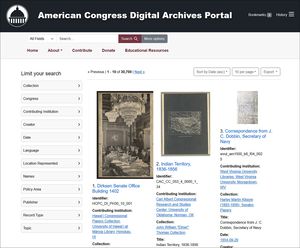
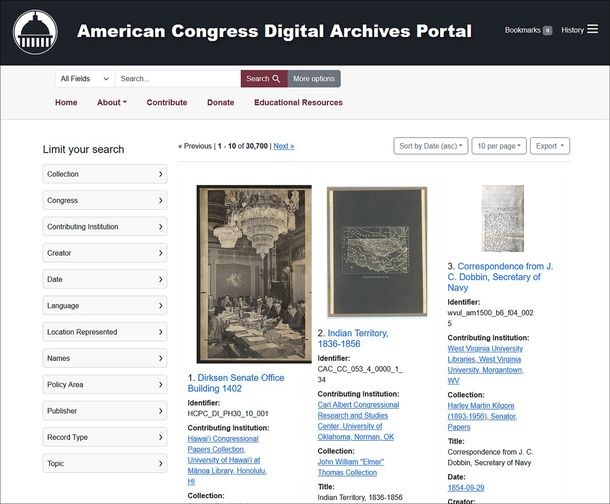
Because there is no congressional equivalent of the presidential library system, members’ collections are distributed across hundreds of repositories nationwide. This system has the benefit of keeping most collections close to the communities that senators represented. But it also creates challenges for broader access to and engagement with the records. The American Congress Digital Archives Portal, led by West Virginia University Libraries, is working to bring congressional collections from repositories across the country into a single open-access online platform. Technology can help to remove the barriers of geography and associated travel costs that have traditionally limited who can easily access these records. A teacher in a small town will have the same access to primary sources as a researcher at a major university. Project archivists intend to include at least one partner institution from every state by 2026, the nation’s 250th anniversary.9
Senators’ records are valuable pieces of the Senate’s historical archival legacy. They connect the work of senators and staff with the constituents they served and link state and local issues to the broader national story. When used alongside the Senate’s official records, they can help to tell a more nuanced and interesting story about America’s evolution as a nation and a people.
Notes
4. “Minutes of meeting with Senator Russell” [Meeting minutes], February 19, 1964, Mike Mansfield Papers, Mss 065, Archives and Special Collections, Maureen and Mike Mansfield Library, University of Montana, accessed March 27, 2026, https://storymaps.arcgis.com/stories/1f99adf4d4d5442b9163aff72e385cd6#ref-n-tN9E5h.
5. “Some observations by Senator Everett McKinley Dirksen on the civil rights bill” March 26, 1964, Everett McKinley Dirksen Papers, Working Papers, f. 257, Dirksen Congressional Center, Pekin, IL, accessed March 27, 2026, https://dirksencenter.org/wp-content/uploads/EMD_Working_Papers-f257-1964_03_26.pdf; Letter from Roy Wilkins to Senator Everett McKinley Dirksen [Correspondence], June 12, 1964, Everett McKinley Dirksen Papers, Working Papers, f. 259, Dirksen Congressional Center, Pekin, IL, accessed March 27, 2026, https://dirksencenter.org/wp-content/uploads/EMD_Working_Papers-f259-1964_06_12.pdf.
6. Danielle Emerling, Hope Bibens, Natalie Bond, John Caldwell, and Alison White, “Archiving Constituent Services Data of the U.S. Congress: A Report of the Society of American Archivists Congressional Papers Section CSS/CMS Task Force,” November 2017, 14, accessed March 27, 2026, https://www2.archivists.org/sites/all/files/2017_CSS_CMS_Report.pdf.
8. Danielle Emerling, “Civics in the Archives: Engaging Undergraduate and Graduate Students with Congressional Papers,” American Archivist, 81, no. 2 (September 2018): 310–22; "Teaching with Primary Resources," University of Kentucky Libraries, accessed April 14, 2026, https://libraries.uky.edu/teaching-support/teaching-primary-sources.
9. Danielle Emerling, "The American Congress Digital Archives Portal Project White Paper" (2022), West Virginia University, Faculty & Staff Scholarship. 3090, accessed March 27, 2026, https://researchrepository.wvu.edu/cgi/viewcontent.cgi?article=4026&context=faculty_publications.