 | 202607 02Senators of the Revolutionary Generation
July 02, 2026
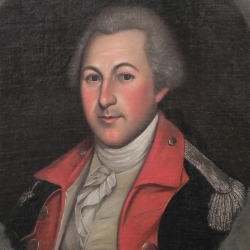
Dozens of the nation’s earliest U.S. senators had contributed to the fight for independence. Their Revolutionary Era service provided them with invaluable experience. Having earned the confidence and admiration of their contemporaries, they were entrusted with the role of senator as the fledgling country implemented its new constitutional republic. In celebration of the semiquincentennial of the Declaration of Independence, we recognize these Revolutionary Era leaders for providing legitimacy, stability, and continuity to the young nation, helping to ensure its longevity.
Two hundred and fifty years ago, in the spring of 1776, John Adams emerged as a leading voice for independence in the Second Continental Congress. Representing Massachusetts, an embattled colony hardened by a year-long British siege, Adams urged the colonies to sever bonds with the British Crown—a bold effort that reached its peak with the adoption of the Declaration of Independence on July 4, 1776. In signing this Declaration, the delegates from 13 individual states united in their revolutionary cause. They asserted that “Governments are instituted among Men, deriving their just powers from the consent of the governed” and claimed that “it is the Right of the People…to institute new Government, laying its foundation on such principles and organizing its powers in such form, as to them shall seem most likely to effect their Safety and Happiness.”
Thirteen difficult and transformative years later, on April 21, 1789, Vice President Adams stood before the newly formed United States Senate and addressed the body as its presiding officer for the first time. Observing the group before him, he acknowledged how important it was that they had answered the call to service under the new constitutional system of government that they had instituted. “At this time…the prosperity of the country, and the liberties of the people, require…the attention of those who possess any share of the public confidence,” Adams insisted. He lauded the senators—his fellow revolutionaries and founders—as “celebrated defenders of the liberties of this country…intrepid asserters of the rights of mankind, whose philosophy and policy have enlightened the world…more than it was ever before enlightened in many centuries.”1
Adams’s observation rang true throughout the Early Republic (1789–1830s), as the Senate included many individuals who had contributed to the revolutionary cause. Several had signed the Declaration of Independence. Many had served courageously in a military capacity during the war. Some had offered political leadership, provided diplomatic service, or rendered financial assistance to the Revolution. “At the Philadelphia [Constitutional] Convention, delegates had discussed the Senate in terms of ‘wise elders,’ ‘defenders of property,’ men of experience, responsibility, stability,” reflected historian Roy Swanstrom. “While wisdom or intelligence are difficult to measure and compare, one other quality can be measured with a fair degree of accuracy—experience,” he noted. “On this test the first Senators rated very high.” As Swanstrom explained, “The Revolution itself, the Congress of the Confederation with its vexing problems, local legislatures and executive branches in the transition from colony to statehood, State constitutional conventions, the Philadelphia Convention and subsequent ratifying conventions—these all provided experiences in statecraft that few other periods have offered.” Noting that nearly all of those who served in the early Senate held at least one of these credentials, he concluded, “The Senate in this early period consisted of a group of men who would have done credit to any legislative body anywhere.”2
Six signers of the Declaration of Independence went on to serve in the Senate. Richard Henry Lee of Virginia, Charles Carroll of Maryland, Robert Morris of Pennsylvania, and George Read of Delaware were among the first senators in 1789. Roger Sherman of Connecticut and George Walton of Georgia served in subsequent Congresses. The political experiences of each of these signers during the Revolutionary Era earned them a large measure of public confidence by the dawn of the Early Republic.3
As a delegate in the Second Continental Congress, Richard Henry Lee (one of Virginia’s first senators) had introduced the resolution proposing independence for the American colonies on June 7, 1776. In addition to declaring "that these united colonies are and of right ought to be free and independent states," the Lee Resolution also called for the states to “plan for a confederation” and form foreign alliances. Before joining the Continental Congress, Lee had served in the Virginia House of Burgesses where he joined in opposition to the policies of the British government. He also helped develop committees of correspondence, the important temporary state governments and colonial communication networks employed throughout the Revolution. After resigning his seat in the Continental Congress in 1779, Lee served as a colonel of the Westmoreland County Militia. Following the British surrender, he became a delegate in the Confederation Congress (the unicameral legislature that was the governing body under the Articles of Confederation), serving as its president for a year. An antifederalist who feared a powerful federal government, Lee favored amending the new Constitution to protect individual liberties. Despite being aged and in ill health, he agreed to join the Senate to ensure that a Bill of Rights was adopted. “[T]o secure civil liberty…was, I assure you, the sole reason that could have influenced me to come here,” Senator Lee wrote to his friend and fellow revolutionary Patrick Henry in May 1789.4
Like Lee, Charles Carroll (who styled himself “of Carrolton” to distinguish him from his father) contributed to the committees of correspondence prior to his service in the Second Continental Congress. Born to a wealthy Irish Catholic family in Annapolis, Maryland, Carroll received extensive formal education in Europe as a young man, returning to Maryland in 1765. A Maryland colonial law prohibiting Roman Catholics from holding office barred him from entering politics. However, writing in the Maryland Gazette under the pseudonym "First Citizen," he became a leading voice for colonial rights, defending independent legislatures and government based upon the consent of the governed. In 1774 the Continental Congress selected him to join a diplomatic mission to Canada to seek aid. During the war, he served in the Maryland Senate, helped draft Maryland’s constitution, and served on the Board of War. The last surviving signer of the Declaration of Independence, he died on November 14, 1832.5
Philadelphia merchant Robert Morris is often referred to as “the financier of the American Revolution” due to his critical role in securing money and supplies to aid in the revolutionary cause. He later served as superintendent of finance under the Confederation Congress. In response to the Stamp Act in 1765, Morris joined with other merchants to boycott British imports. Though he believed independence to be premature in July 1776, he did not attend the vote on the Lee Resolution, thus allowing the Pennsylvania delegation to support passage, and he ultimately signed the Declaration. As a delegate to the Continental Congress, Morris led several important committees related to foreign affairs and securing supplies for the war effort. In addition to providing financial leadership during the Revolutionary Era, Morris also served in the Pennsylvania Assembly, represented his state at the Constitutional Convention in 1787, and signed the Constitution. Morris became one of the first two United States senators (along with William Maclay) when Pennsylvania became the first state to elect its senators in 1788.6
As a Delaware assemblyman in the 1760s, George Read had participated in the colonial resistance efforts, including boycotts and committees of correspondence. He nevertheless hesitated to support independence, hoping to peaceably reconcile with Britain. On July 2, 1776, Read voted against the Lee Resolution. Following its adoption, however, he willingly joined with his fellow delegates in signing the document. He is the only signatory who voted against it. In 1776 Read was also deeply engaged in the organizational matters of his state, drafting Delaware’s constitution and presiding over its constitutional convention. After the British captured Delaware’s president during the Revolutionary War, Read—then vice president of Delaware—barely evaded capture himself when he returned from the Continental Congress in Philadelphia to assume the state presidency. Following the war, he served again as a state legislator and as judge of the court of appeals in admiralty cases. In 1786 Read joined representatives from five states to revise the flawed Articles of Confederation at the Annapolis Convention. One year later, he attended the Constitutional Convention, representing the interests of the small states and favoring a strong central government. He signed the Constitution, and thanks largely to his efforts, Delaware became the first state to ratify it in December 1787.7
When Roger Sherman of Connecticut took his Senate seat in 1791 at the age of 70, he was preeminent even among his experienced contemporaries. He is the only person to have signed the Articles of Association of 1774, the Declaration of Independence, the Articles of Confederation, and the Constitution. Self-educated and a cobbler by trade, he was first elected to the Connecticut Assembly in 1755 and went on to serve as a state senator and a state superior court judge. He attended the First Continental Congress in 1774 and the Second Continental Congress in 1775, serving on the "Committee of Five" appointed to draft the Declaration, alongside Thomas Jefferson, John Adams, Benjamin Franklin, and Robert R. Livingston. During the Revolutionary War, he helped stockpile munitions and other provisions as a member of Connecticut’s council of safety. At the Constitutional Convention, it was Sherman who crafted (with the support of his Connecticut colleague—also a future senator—Oliver Ellsworth) the so-called Great Compromise (or Connecticut Compromise), which provided for equal representation of the states in the Senate and proportional representation in the House of Representatives. Sherman had first proposed the idea of a bicameral legislature with mixed representation in 1776, during the Continental Congress debates over a national government framework. “Everything depended on this,” Sherman argued in 1787. “The smaller States would never agree to the plan on any other principle than an equality of suffrage” in the Senate.8
George Walton of Georgia, the last signer of the Declaration to serve in the Senate, filled a Senate vacancy by appointment in 1795. Orphaned as a young child, Walton developed a love of learning and studied law. He became a leader in Georgia’s revolutionary movement, helping to organize the colony’s Provincial Congress and serving as its secretary. He served as president of Georgia’s Council of Safety (a wartime executive body) before his selection as a delegate to the Second Continental Congress. Walton arrived just one day before the vote on the Lee Resolution, in time to hear John Adam’s final impassioned speech in favor of independence. He was the youngest signer of the Declaration of Independence. During the war, as a colonel in the Georgia Militia, he was wounded in the leg and subsequently captured by the British during the siege of Savannah in 1778. A year later, the British released him in a prisoner exchange. He then briefly served as governor of Georgia in 1779 (a position he would hold again in 1789). After the war, he became chief justice of Georgia. Elected as a delegate to the Constitutional Convention in 1787, he declined to attend.9
The senators who had signed the Declaration, and many other senators from the Revolutionary generation, garnered extensive political experience throughout the period. More than 70 of these senators also gained valuable experience through their contributions to the war effort. Some demonstrated extraordinary valor as battlefield soldiers. Some were commissioned officers and ranked among the military leadership. Richard Bassett of Delaware was a captain of a cavalry regiment in the state militia. James Gunn of Georgia served as a captain of dragoons, a mounted regiment. Philip John Schuyler of New York, a former officer in the British army during the Seven Years’ War, was commissioned one of four major generals in the Continental Army. Rhode Island’s Joseph Stanton, Jr., served as a colonel in the state militia. Appointed captain at the age of 23 in 1776, Maryland’s John Eager Howard rose to the rank of colonel by the war’s end. The Confederation Congress awarded him a silver medal for his gallantry in leading a decisive bayonet charge at the Battle of Cowpens in 1781.10
At age 17, future senator and president James Monroe of Virginia left the College of William and Mary to enlist in the Continental Army. As a lieutenant in the Third Virginia Regiment, he crossed the icy Delaware River with General George Washington’s troops and was severely wounded during the Battle of Trenton. He recovered and fought in numerous other engagements during the war. Though just a young boy, future senator and president Andrew Jackson of Tennessee participated as a courier in the battle of Hanging Rock during the Revolution. While engaged in battles near his home in the Waxhaw Settlement in South Carolina, he was captured and wounded by a British officer after defying the officer’s order to polish his boots.11
John Condit of New Jersey and Michael Leib of Pennsylvania were surgeons during the war, as was Delaware’s Henry Latimer, who served in a mobile surgical unit known as the “flying hospital.” John Laurance of New York, who had immigrated to America in 1767, attained the rank of colonel as a commissioned officer. As judge advocate general, Laurance prosecuted the 1779 court martial of Major General Benedict Arnold for misconduct and the trial of Major John André, the British army officer who was sentenced to death for conspiring with an embittered Arnold for the surrender of West Point.12
Several future senators held administrative posts in the Continental Army. Colonel Timothy Pickering of Massachusetts was adjutant general and quartermaster general. William Maclay of Pennsylvania (remembered for the revealing diary he kept during the First Congress) served as a commissary. Connecticut’s Jonathan Trumbull, Jr., was a paymaster general for the northern region and earned the rank of lieutenant colonel before his appointment as military secretary to General Washington in 1781. Future Virginia Senators William Grayson, John Walker, and Stevens Thomson Mason all served as aides-de-camp to Washington, a fellow Virginian. Rufus King of New York was aide-de-camp to General John Glover. Benjamin Hawkins of North Carolina served as an interpreter for Washington.13
Robert Morris was not alone in helping to finance the Revolution. New Hampshire’s John Langdon (the Senate’s first president pro tempore) secured military supplies, oversaw the building of several war ships, and staked his personal fortune to equip General John Stark’s pivotal expedition against British General John Burgoyne. Ralph Izard of South Carolina pledged his large estate to pay for warships.14
Dozens of the nation’s earliest U.S. senators had contributed to the fight for independence. Their Revolutionary Era service provided them with invaluable experience. Having earned the confidence and admiration of their contemporaries, they were entrusted with the role of senator as the fledgling country implemented its new constitutional republic. In celebration of the semiquincentennial of the Declaration of Independence, we recognize these Revolutionary Era leaders for providing legitimacy, stability, and continuity to the young nation, helping to ensure its longevity.
Notes
1. Senate Journal, 1st Cong., 1st sess., April 21, 1789, 14.
2. Roy Swanstrom, The United States Senate 1787–1801: A Dissertation on the First Fourteen Years of the Upper Legislative Body, reprinted as S. Doc. 100-31, 100th Cong., 1st sess. (Washington, DC: Government Printing Office, 1988), 36.
3. Biographical information referenced throughout this essay can be found in the individual entries of these senators in the online Biographical Directory of the United States Congress, https://bioguide.congress.gov/.
4. Adoption of the Resolution Calling for Independence from England; 7/2/1776; Reports on Administrative Affairs of the Congress; Papers of the Continental Congress, 1774–11789; Records of the Continental and Confederation Congresses and the Constitutional Convention, Record Group 360; National Archives Building, Washington, DC, accessed June 16, 2026, https://www.archives.gov/milestone-documents/lee-resolution; Dictionary of American Biography, s.v. “Lee, Richard Henry (Jan. 20, 1732-June 19, 1794)”; James Curtis Ballagh, ed., The Letters of Richard Henry Lee (New York: The Macmillan Company, 1914), 2: viii, 488.
5. “Charles Carroll Statue,” Architect of the Capitol, accessed June 15, 2026, https://www.aoc.gov/explore-capitol-campus/art/charles-carroll-statue.
6. "Meet the Framers of the Constitution," National Archives, accessed June 15, 2026, https://www.archives.gov/founding-docs/founding-fathers.
7. Dictionary of American Biography, s.v. “Read, George (Sept. 18, 1733-Sept. 21, 1798).”
8. "Meet the Framers of the Constitution," National Archives, accessed June 15, 2026, https://www.archives.gov/founding-docs/founding-fathers; “Roger Sherman Statue,” Architect of the Capitol, accessed June 15, 2026, www.aoc.gov/explore-capitol-campus/art/roger-sherman-statue; "Madison Debates, June 11, 1787," The Avalon Project, accessed June 15, 2026, https://avalon.law.yale.edu/18th_century/debates_611.asp.
9. Edwin Clifford Bridges, "George Walton: A Political Biography." Ph.D. dissertation, University of Chicago, 1981; Josephine Mellichamp, Senators from Georgia (Huntsville, Alabama: The Strode Publishers, Inc., 1976), 37–142.
10. Dictionary of American Biography, s.v. “Schuyler, Philip John (Nov. 20, 1733-Nov. 18, 1804)”; “Meet the Framers of the Constitution,” National Archives, accessed June 15, 2026, https://www.archives.gov/founding-docs/founding-fathers.
11. “Monroe, James (1758–11831),” in The American Revolution, 1775-1783: An Encyclopedia, eds., Richard L. Blanco and Paul J. Sanborn (New York: Garland Publishing, 1993), 1088–190; Robert V. Remini, Andrew Jackson and the Course of American Empire, 1767-1820 (New York: Harper & Row, 1977), 17–122.
12. Swanstrom, The United States Senate, 39; Keith Marshall Jones III, John Laurance: The Immigrant Founding Father America Never Knew (Philadelphia: American Philosophical Society Press, 2019), 71–173. American National Biography, s.v. “Laurance, John (1750-11 Nov. 1810).”
13. Robert Ernst, Rufus King: American Federalist (Chapel Hill: Published for the Institute of Early American History and Culture at Williamsburg, Va., by University of North Carolina Press, 1968), 25.
14. Swanstrom, The United States Senate, 39.
|
 | 202606 26Lights! Camera! Action! The Senate Televised
June 26, 2026
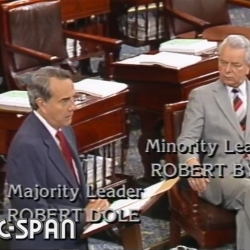
Forty years ago, on June 2, 1986, President pro tempore Strom Thurmond of South Carolina gaveled in the Senate, just as he did most days. Guest Chaplain Bernard Hawley began the day’s session with a prayer, as the Senate began each day of its proceedings. But this was no ordinary day in the Senate. Majority Leader Robert Dole of Kansas declared in his opening remarks, “Today we catch up with the 20th century.” In a monumental change to the tradition-bound Senate, Leader Dole was broadcast live from the Senate Chamber to the American people on radio and television.
Forty years ago, on June 2, 1986, President pro tempore Strom Thurmond of South Carolina gaveled in the Senate, just as he did most days. Guest Chaplain Bernard Hawley began the day’s session with a prayer, as the Senate began each day of its proceedings. But this was no ordinary day in the Senate. Majority Leader Robert Dole of Kansas declared in his opening remarks, “Today we catch up with the 20th century.” In a monumental change to the tradition-bound Senate, Leader Dole was broadcast live from the Senate Chamber to the American people on radio and television.1
Televised Senate proceedings had been a long time coming. In November 1947, the Senate for the first time televised a committee hearing—testimony by Secretary of State George Marshall on his plan to aid war-torn Europe. Households owning a television surged in the years following, growing to five million in 1950. In 1951 Tennessee Senator Estes Kefauver’s organized crime investigation became a national television event. The Army-McCarthy hearings launched a veritable media circus in 1954, when half of U.S. households owned a television set. In 1960 producers at ABC proposed televising Senate debates. Reporters approached Democratic Whip Mike Mansfield of Montana. Did he agree with the idea? “I sure as hell do not,” he snapped. “Television would amount to offering entertainment,” Mansfield insisted, “and this is no place for entertainment.”2
Senator Jacob Javits of New York raised the idea of television coverage in 1963 and again in 1965, but during Mansfield’s 16 years as majority leader, from 1961 to 1977, cameras made it into the Senate Chamber only once. As it became increasingly likely that the Senate would hold an impeachment trial of President Richard Nixon for his role in the Watergate scandal, the Senate, in anticipation of massive public interest, made provisions for the first live television coverage from the Chamber. Several months after Nixon’s resignation made a trial unnecessary, Majority Whip Robert Byrd of West Virginia, acting as majority leader while Mansfield was out of the country, secured Senate approval to telecast Nelson Rockefeller’s December 19 swearing-in as vice president.3
The Senate considered bringing cameras into the Chamber on several additional occasions in the mid-to-late 1970s and early 1980s, but plans failed to materialize. The Joint Committee on Congressional Operations, created in 1970, issued a report in 1974 recommending that the House and Senate conduct a test of the feasibility of cameras in their Chambers. Senators discussed televising floor debate on the contested New Hampshire election between Republican Louis Wyman and Democrat John Durkin in 1975, but disagreements over setting a time limit for debate scuttled the plan. In 1976 the Commission on the Operation of the Senate—popularly known as the Culver Commission—recommended again that the Senate test televising its proceedings. Majority Leader Robert Byrd authorized a camera and lighting test in the Chamber as he considered whether to televise the extended debate on the Panama Canal Treaties in 1978, but the lights proved to be too hot and bright for senators on the floor. Proposals to televise Senate debate on a nuclear arms treaty with the Soviet Union were not acted upon.4
In 1981 Republican Leader Howard Baker of Tennessee, now leading the majority, took up the cause of televising Senate proceedings. The House of Representatives in 1979 had begun broadcasting its gavel-to-gavel proceedings on a newly created non-profit cable network dedicated for that purpose, the Cable-Satellite Public Affairs Network, or C-SPAN. Baker worried that the greater public attention to the House threatened to turn the Senate into the invisible half of Congress. C-SPAN CEO Brian Lamb hoped to expand its coverage to the Senate. A C-SPAN survey in early 1981 indicated that 57 senators—36 Republicans and 21 Democrats—favored some form of television coverage of Senate proceedings with only 19 against, but there were many questions that had to be answered first. Would the Senate broadcast all its floor proceedings or just a selection of debates? How many cameras would be required? Where should they be mounted and would they detract from the Chamber’s historic appearance? In February 1981, the Rules Committee permitted another round of camera and lighting testing in the Chamber, and committee staff issued a report summarizing the results and recommending further consideration.5
For Howard Baker, however, the questions at hand were not technical ones, but about what kind of institution the Senate ought to be. He believed that the Senate was no longer a deliberative body and lamented that the Chamber floor had lost its importance as a central forum in the legislative process. Baker thought television coverage was the first step in reviving floor debate. In testimony before the Rules Committee, chaired by Charles McCurdy Mathias, Jr., of Maryland—who supported the proposal—Baker asserted that “televised proceedings will allow the people of this country to better understand us, to understand the system, to understand the Senate and the Congress, and will permit us to fulfill better our responsibilities to the Nation.” Baker asserted that “the Senate has a special and unique and historic role. But we are not performing it.” For Baker, television was “the most important single thing” the Senate could do for it “actually to become the great deliberative body which it was thought to be when it was created.” Alongside the introduction of cameras, Baker proposed rules changes that he believed would bring more senators to the Chamber to engage in substantive debate. He predicted that more public attention to the Chamber would motivate senators to adopt further reforms.6
Baker faced staunch opposition in the Rules Committee. Republican John Warner of Virginia bristled at Baker’s critique of the Senate and the idea that “that machine,” television, was the solution. Republican Mark Hatfield of Oregon argued that the most important work in the modern Senate took place in committee rooms and doubted that television cameras would do much to bring deliberation back to the Chamber floor. Democrat Wendell Ford of Kentucky predicted that the public would not like what they see of the Senate floor—speeches to empty seats and long quorum calls. Ford also balked at the cost of installing the system—estimated to be between $2.5 and $3.5 million—at a time when reducing federal spending was a key topic of discussion. Ford preferred to limit Senate broadcasts to radio. Democrat Russell Long of Louisiana believed that television would lead to senators playing to the cameras and increase the number of long speeches. “The greatest surplus commodity we have in the Congress are speeches that need never be made,” he said, “speeches that fail to improve on silence.”7
Despite the pushback, the Rules Committee reported Baker’s resolution favorably to the full Senate in July 1981, but lacking broad support and facing a threatened filibuster by Long, Baker postponed consideration to the following year. In April 1982, the Senate passed a version of the resolution that required the Rules Committee to draft regulations to govern television and radio coverage of the Chamber. But when Rules reported the required regulations in July, consideration once again stalled. Baker did not bring the topic back to the full Senate again until fall 1984, when a cloture vote on his resolution failed to muster even a bare majority. Baker gave up. “It is clear to me this is an idea whose time has not come.”8
In 1985 Baker resigned his Senate seat to become chief of staff to President Ronald Reagan. The new majority leader, Robert Dole of Kansas, picked up the torch and joined forces with Democratic Leader Robert Byrd to put television coverage back before the Senate. Byrd had initially been skeptical of televised proceedings, but he changed his mind after being erroneously introduced to a West Virginia audience as the Speaker of the House. “That was a warning to me,” Byrd explained, “that we’d better go on television.” Byrd was not the only one warming to the idea. C-SPAN conducted another survey of senators and found that 62 supported the proposal, 18 opposed in any form, and only 5 remained uncommitted. After another round of hearings by the Rules Committee, Byrd introduced a resolution providing for an initial trial run of closed-circuit broadcast for senators’ offices only, to be followed by a six-week trial of a national broadcast. After weeks of debate and negotiation, the Senate finally approved the trials.9
The closed-circuit trial went smoothly, and on June 2 the Senate was ready for its national radio and television debut. In his opening remarks, Leader Dole expressed his hope that welcoming Americans into the Chamber would improve the Senate’s efficiency. He acknowledged the presence of former Senator Howard Baker, on hand to witness the historic occasion. As he often did, Byrd put the milestone into historical context, quoting 19th-century British poet laureate Lord Alfred Tennyson, “The old order changeth, yielding place to new.” Senator Alan Cranston of California declared that “for serious Americans who take their country seriously, this is the show to watch.”10
Other senators had fun with the moment. Alabama’s Howell Heflin recited a sonnet: “Turn the spotlight over here; Focus the camera at my place; Pages, please don’t come near; Otherwise you just might block my face.” John Glenn of Ohio assured the audience that despite the cameras, “I plan to do nothing different.” As he spoke, he pulled out a compact and brush and applied powder to his balding head to dull the shine produced by the bright lights and added a few dabs to cover the bags under his eyes. The first day of broadcasting ended with a 25-minute quorum call, suggesting that Dole’s hopes for greater efficiency might not come to pass.11
By the terms of the resolution, after six weeks of live broadcasts, the Senate pulled the plug on the cameras on July 15 for two weeks of discussion among members about the merits of televised proceedings. Dole was so pleased that he proposed forgoing the break. Senator Al Gore of Tennessee, who had commissioned a study by the Congressional Research Service to compare Senate proceedings before and after the cameras turned on, reported that the Senate had spent more time on legislation and less time in quorum calls. Rules Committee Chair Charles Mathias presented to the Senate a host of suggestions from senators for improving the system, from better camera angles to changing the color of the Chamber walls to eliminating audio during roll-call votes. Finally, after hours of floor debate on July 29, 1986, senators voted 78 to 21 to turn the cameras on—permanently.12
In the years and decades that followed, the Senate expanded its broadcast coverage to encompass all public committee hearings, giving the American public the window into the democratic process that Senator Howard Baker had wished for. Television coverage may have brought the Senate into the 20th century, but the Senate has since embraced the technologies of the 21st century, with live streams of each daily session on C-SPAN and Senate.gov.
Notes
1. “Senate Session (June 2, 1986),” C-SPAN, accessed June 10, 2026, https://www.c-span.org/program/senate-highlight/senate-session-june-2-1986/36237.
2. Senate Committee on Foreign Relations, Emergency Foreign Aid, 80th Cong., 1st sess., November 10–14, 1947, 2–39; Arthur Vandenberg to Bill Henry, Radio Correspondents Association, December 30, 1947, Senate Historical Office Files; United States Census Bureau, “History and the Census: Philo Farnsworth and the Invention of Television,” September 1, 2023, accessed June 10, 2026, https://www.census.gov/about/history/stories/monthly/2023/september-2023.html; “Capital Circus,” New York Daily News, August 9, 1960, 4.
3. Congressional Record, 88th Cong., 1st sess., May 14, 1963, 8394; Kenneth Keating, “Not ‘Bonanza,’ Not ‘Peyton Place,’ But the US Senate!” New York Times, April 25, 1965, SM67; Resolution to permit radio, television, and photographic coverage of the swearing-in-ceremony of the Vice President of the United States, S. Res. 452, 93rd Cong., 2nd sess., December 14, 1974; “Senate Ceremony,” New York Times, December 20, 1974, 1.
4. Spencer Rich, “Test TV Coverage Of Senate Urged,” Washington Post, September 7, 1976, A20; Senate Committee on Rules and Administration, Television and Radio Coverage of Proceedings in the Senate Chamber: Hearings on S. Res. 20, 97th Cong., 1st sess., April 8, April 9, May 5, 1981, 16–25.
5. “Lights, Cameras, No Action in Empty Senate,” Los Angeles Times, February 9, 1981, A2; “Poll Shows Senators in Favor of TV,” Roll Call, March 5, 1981, 1; Television and Radio Coverage, 16–25.
6. Television and Radio Coverage, 3–9; “Senate Television,” in CQ Almanac 1981 (Washington, DC: Congressional Quarterly, 1982), 391.
7. Television and Radio Coverage, 10, 13–16, 73–75.
8. Rich Burkhardt, “Senate Embraces Television,” Roll Call, July 29, 1982, 1; “Baker Loses Last Bid for TV in the Senate,” New York Times, September 23, 1984, 34; Rich Burkhardt, “TV Blacked Out in Senate,” Roll Call, September 27, 1984, 1.
9. C-SPAN, Press Release, “New C-SPAN Poll Shows Senate TV Gaining Ground,” August 26, 1985, Senate Historical Office Files; “Senate Debates Rules Changes As Prelude to TV Coverage,” CQ Inside Congress, (Washington, DC: Congressional Quarterly), February 22, 1986, 467; Helen Dewar, “Senators Keep Leeway for Nongermane Riders,” Washington Post, February 27, 1986; Helen Dewar, “The Video Senate’s Peer Preview,” Washington Post, May 2, 1986, A17; “A Quarter Century Ago the Senate Was Ready For Its Close up,” Washington Post, June 7, 2011; To Improve Senate Procedures, S. Res. 28, 99th Cong., 2nd sess., February 27, 1986.
10. Congressional Record, 99th Cong., 2nd sess., June 2, 1986, 12042, 12047.
11. “Senate Session (June 2, 1986)” C-SPAN, accessed June 10, 2026, https://www.c-span.org/program/senate-highlight/senate-session-june-2-1986/36237.
12. Congressional Record, 99th Cong., 2nd sess., July 29, 1986, 17879–82; 17905.
|
 | 202508 29Fifty Years of Preserving and Promoting Senate History
August 29, 2025
In May 1974, Pulitzer Prize-winning biographer and political historian Arthur Schlesinger, Jr., wrote a letter to Senate Majority Leader Mike Mansfield supporting a proposal to establish a Senate Historical Office. “The creation of such an Office would be of benefit,” Schlesinger wrote, “not only to historians and concerned citizens but to the Senate itself.” The next year, with the bipartisan blessing of Mansfield and Republican leader Hugh Scott, the Senate Historical Office was established on September 1, 1975.
In May 1974, Pulitzer Prize-winning biographer and political historian Arthur Schlesinger, Jr., wrote a letter to Senate Majority Leader Mike Mansfield supporting a proposal to establish a Senate Historical Office. “The creation of such an Office would be of benefit,” Schlesinger wrote, “not only to historians and concerned citizens but to the Senate itself.” Schlesinger understood that the twin political crises of the 1970s—the Watergate scandal and the unpopular Vietnam War—had caused a growing number of Americans to lose faith in their institutions and to demand greater transparency from them. “If we are going to persuade the nation that Congress plays a role in the formation of national policy,” he wrote, “Congress will have to cooperate by providing the evidence for its contributions.” The next year, with the bipartisan blessing of Mansfield and Republican leader Hugh Scott, the Senate Historical Office was established on September 1, 1975.1
Tasked with overseeing the new office, Secretary of the Senate Francis Valeo articulated its mission. “Executive Branch departments and agencies have long had large historical offices and have long published or made public many of their important confidential papers,” Valeo explained in a letter to Senate appropriators justifying the creation of the new office. A Senate historical office would assist in the “organization of the Senate’s historic documentation,” serve as a “clearing house for public requests concerning historical subjects,” and “collect and preserve photographs depicting the history of the Senate.”2
Valeo hired Richard Baker to lead the new office. Baker brought a unique blend of skills and experience to the role. With degrees in history and library science, Baker had served as the Senate’s acting curator from 1969 to 1970 and then as vice president and director of research for the National Journal’s parent company. Former Washington Times staff photographer Arthur Scott filled the position of photo historian. Baker soon hired Leslie Prosterman as a research assistant and Donald Ritchie as a second historian.
Historians and newspapers heralded the office’s creation. “On behalf of the [American Historical] Association I want you to know how pleased we are that the Senate has established this new historical office,” wrote Mack Thompson, the organization’s executive director. “Much of the Senate’s business in the past was conducted in closed committee meetings,” noted Roll Call, leaving Senate records “locked away and forgotten,” resulting in the “history of significant public policy issues [being] written from the perspective of the Executive Branch where confidential records are generally declassified and published on a systematic basis.” The New York Times predicted that there would be much interest in the Senate’s “closed-door briefings on Pearl Harbor, the Cuban missile crisis, and the missile-gap controversy of the Eisenhower administration.” Generations of reporters, historians, and political scientists would come to rely upon the non-partisan expertise provided by Senate historians.3
One of the office’s most pressing early tasks was locating and arranging for the proper preservation of the Senate’s “forgotten” records. “Most senators in 1975 had given little thought to their papers,” recalled Baker in an oral history interview in 2010. Baker’s job was to persuade senators that selecting a repository for their papers was “prudent management practice … in the interest of public access.” There was much work to be done. Baker found humid attic and dank basement storerooms in the Russell Senate Office Building filled to overflowing with committee and member papers. A recent basement flood had destroyed 30 years of irreplaceable materials. Similarly, attic spaces, where temperatures soared in the summer and the prospect of a fire was not unthinkable, were ill-suited for safely preserving records. Racing the clock, Senate historians appraised collections and helped arrange for their long-term preservation. “Our major role is advisory,” Baker wrote during those early years. “We do not intend to build our own archives … [but to facilitate] the flow of archival materials to repositories where they will receive sufficient care and exposure.”4
The tidal wave election of November 1980 brought renewed urgency to Senate historians’ work. Eighteen departing senators had only a few months to vacate their offices. Some were leaving voluntarily, while others had been unexpectedly retired by their constituents. Historical Office staff scrambled to assist departing members—including Warren Magnuson of Washington State and Jacob Javits of New York, whose combined congressional service totaled 78 years—with moving their voluminous record collections to hastily designated repositories. Soon after that election, Baker hired Karen Paul as the Senate’s first archivist. Paul would devote the next 43 years of her career to advising senators, staff, and officers on the preservation and disposition of their records, developing archival policies and practices to ensure the preservation of Senate records for future generations, and building a community of professional Senate archivists.
Over the past five decades, the Senate Historical Office has built partnerships and institutional capacities to aid in the preservation of congressional records for the long term. Working with congressional leadership, the Historical Office helped to establish a separate division within the National Archives to serve as the official repository for congressional committee records in 1985—named the Center for Legislative Archives in 1988. In 1990 the Office co-founded the Advisory Committee on the Records of Congress to explore issues pertinent to congressional records management, and it co-created the Association of Centers for the Study of Congress in 2004, a nationwide consortium of congressional records repositories and research institutes. Today, Senate archivists continue to advance the Senate’s historical record by shaping how its documentation is preserved and accessed. They have developed and updated official records management policies and have pioneered digital preservation practices, creating workflows for archiving email, social media, and audiovisual records in line with national standards. Senate archivists also provide specialized staff training that equips members and support offices, as well as committees, to manage both paper and electronic records with confidence. The Historical Office also administers the Secretary of the Senate’s Preservation Partnership Grants that strengthen the capacity of repositories across the country to process and provide access to senators’ papers, broadening the range of materials available for research. This work safeguards the very documentation on which Senate history rests.
While preserved official records illuminate aspects of Senate history, they rarely tell the full story of an institution’s evolution. From the Historical Office’s earliest days, Senate historians have sought to document the social, cultural, and technological changes within the Senate with the Senate Oral History Project. Don Ritchie developed and led the project, with a mission to record and preserve the experiences of a diverse group of personalities—both staff and senators—who witnessed events firsthand and offer a unique perspective on Senate history. Interviews help to explain, for example, women’s evolving role in the Senate, and the impact of changing technology on the institution. There were no women senators serving in 1975, while 26 women serve in the 119th Congress. Only one senator’s office used a computer in 1975 to manage constituent services, while today, emails, the internet, and social media are ubiquitous Senate-wide. Collectively, these oral histories help to promote a fuller and richer understanding of the institution’s evolution and of its role in governing the nation.
The advent of the internet in the mid-1990s provided new opportunities to share Senate history with a broader range of audiences. When Betty Koed joined the team as assistant historian in 1998, she began populating the (then relatively) new Senate website with oral history transcripts and historical information. Today, the Historical Office has integrated a wealth of Senate history across Senate.gov, created a Senate Stories blog, and developed online exhibits including “The Civil War: The Senate’s Story,” “The Civil Rights Act of 1964,” “States in the Senate,” and “Women of the Senate.”
Since its founding, the Historical Office has developed and maintained a reputation among senators, staff, journalists, scholars, and the general public for providing fact-based, non-partisan information about the institution’s history. Its staff manage dozens of statistical lists and maintain information about senators and vice presidents in the online Biographical Directory of the United States Congress. Historians lead custom tours for members and staff and deliver history “minutes”—brief Senate stories about a subject of their choosing—at the party conference luncheons and for the Senate spouses. They offer brown bag lunch talks, deliver committee and state legacy briefings, and host an annual Constitution Day event. Historical Office staff have provided background and research support for dozens of books on the Senate, as well as historic events such as inaugural ceremonies, three presidential impeachment trials, and the 1987 congressional session convened in Philadelphia to commemorate the bicentennial of the Great Compromise which paved the way for the signing of the U.S. Constitution.
In addition to these varied services, Senate historians have supported a number of projects for members and committees, including Senator Robert C. Byrd’s four-volume The Senate, 1789–1989; Senator Robert Dole’s Historical Almanac of the United States Senate; the executive sessions of the Committees on Homeland Security and Governmental Affairs (1953) and Foreign Relations (1947–1968); and Senator Mark Hatfield’s Vice Presidents of the United States, 1789–1993. The Historical Office team has authored print publications including the United States Senate Election, Expulsion and Censure Cases, 1793–1990 (1995); 200 Notable Days: Senate Stories 1787–2002 (2006); Scenes: People, Places, and Events That Shaped the United States Senate (2022); and Pro Tem: Presidents Pro Tempore of the United States Senate (2024). The Office has helped to document party histories by editing the minutes of the Republican and Democratic Conferences and producing A History of the United States Senate Republican Policy Committee, 1947–1997. These publications have been illustrated, in part, with images drawn from the Historical Office’s rich photo collection.
During the past half-century, the Historical Office has adapted to meet the needs of an ever-evolving institution while continuing to provide the services first articulated by Secretary of the Senate Valeo in 1975. Today, its staff of 12 historians and archivists are dedicated to preserving and promoting Senate history for the next 50 years.
Notes
1. Letter from Arthur Schlesinger, Jr., to the Honorable Mike Mansfield, May 6, 1974, in Senate Historical Office files.
2. Senate Committee on Appropriations, Legislative Branch Appropriations for Fiscal Year 1976: Hearings on H.R. 6950, 94th Cong., 1st sess., April 21, 1975,1258.
3. Mack Thompson to Mr. Richard Baker, March 25, 1976, in Senate Historical Office files; “Senate Historian,” Roll Call, October 23, 1975; “Senate Office To Publish Declassified Documents,” New York Times, October 19, 1975.
4. "Richard A. Baker: Senate Historian, 1975–2009," Oral History Interviews, May 27, 2010, to September 22, 2010, Senate Historical Office, Washington, D.C.; Richard A. Baker, “Managing Congressional Papers: A View of the Senate,” American Archivist 41, no. 3 (July 1978): 291–96.
|
 | 202409 17Constitution Day 2024: The Senate’s Power of Advice and Consent on Nominations
September 17, 2024
Through its power of advice and consent on nominations, the Senate serves a pivotal role in the complex system of check and balances established by the framers of the Constitution. While the way in which the Senate has exercised that power has evolved over the course of its history, it has consistently fulfilled this important responsibility. This selection of historical documents relates to the establishment and exercise of the Senate’s power of advice and consent on nominations.
To encourage Americans to learn more about the Constitution, Congress designated September 17—the date in 1787 when delegates to the federal convention signed the Constitution—as Constitution Day.
Throughout the summer of 1787, the framers of the Constitution debated where to place the power to make executive and judicial appointments. Eventually, they settled on the concept of a shared power—the president would make appointments with the “advice and consent” of the Senate. Article II, section 2 of the United States Constitution provides that the president "shall nominate, and by and with the Advice and Consent of the Senate, shall appoint Ambassadors, other public Ministers and Consuls, Judges of the Supreme Court, and all other Officers of the United States, whose Appointments are not herein otherwise provided for.”
The president nominates all federal judges in the judicial branch and specified officers in cabinet-level departments, independent agencies, the military services, the Foreign Service, and uniformed civilian services, as well as U.S. attorneys and U.S. marshals. The vast majority are routinely confirmed, while a small but sometimes highly visible number of nominees fail to receive action or are rejected by the Senate. In its history, the Senate has confirmed 128 Supreme Court nominations and well over 500 cabinet nominations.
The following is a selection of historical documents related to the establishment and exercise of the Senate’s power of advice and consent on nominations.
John Adams’s Thoughts on Government, 1776
Written in the spring of 1776, John Adams’s Thoughts on Government was first drafted as a letter to North Carolina’s William Hooper, a fellow congressman in the Continental Congress, who had asked Adams for his views on forming a plan of government for North Carolina’s constitution. Adams developed several additional drafts for other colleagues in the following months, and the letter was ultimately published as a pamphlet. Adams’s plan called for three separate branches of government (including a bicameral legislature), which operated within a system of checks and balances, including a shared appointment power. Drawing from similar language in a 1691 Massachusetts’s colonial charter, and referencing a part of the legislative body he called the “Council,” Adams recommended that “The Governor, by and with and not without the Advice and Consent of the Council should nominate and appoint all Judges, Justices, and all other officers civil and military, who should have Commissions signed by the Governor.” Several years later, in 1780, Adams drew from his plan as he helped to write Massachusetts's constitution, which would include the shared appointment power and the phrase “advice and consent.”
In 1787, during the Constitutional Convention, the appointment or nomination clause split the delegates into two factions—those who wanted the executive to have the sole power of appointment, and those who wanted the national legislature, and more specifically the Senate, to have that responsibility. The latter faction followed precedents established by the Articles of Confederation and most of the state constitutions, which granted the legislature the power to make appointments, while the Massachusetts Constitution, with its divided appointment power, provided an alternative model, which was ultimately selected for the U.S. Constitution.
Report of the Grand Committee, September 4, 1787
After debating the appointment clause over the course of several weeks during the Constitutional Convention, the framers eventually settled on the concept of a shared power. Initially, the delegates granted the president the power to appoint the officers of the executive branch and, given that judges’ life-long terms would extend past the authority of any one president, allowed the Senate to appoint members of the judiciary. On September 4, 1787, however, as the proceedings of the convention were nearing conclusion, the Committee of Eleven (also known as the “Grand Committee”)—a special committee consisting of one delegate from each represented state that regularly met to resolve specific disagreements—reported an amended appointment clause. Unanimously adopted on September 7 and based on the Massachusetts constitutional model, which had been recommended earlier during the course of the debates by Massachusetts delegate Nathaniel Gorham, the clause provided that the president shall nominate and, with the advice and consent of the Senate, appoint the officers of the United States.
Nomination of Alexander Hamilton to be Secretary of the Treasury, 1789
On September 11, 1789, the new federal government under the Constitution took a large step forward. On that day, President George Washington sent his first cabinet nomination to the Senate for its advice and consent. Minutes later, perhaps even before the messenger returned to the president’s office, senators approved unanimously the appointment of Alexander Hamilton to be secretary of the treasury.
Hamilton’s place in history as the Senate’s first consideration and confirmation of a cabinet nominee is fitting as he had participated in the creation of this shared power. At the Constitutional Convention, and in the subsequent campaign to ensure the Constitution’s ratification, Hamilton was convinced that Senate confirmation of nominees would be a welcome check on the president and supported provisions that divided responsibility for appointing government officials between the president and the Senate. Defending the structure of the appointing power in Federalist 76, Hamilton wrote that the “cooperation of the Senate” in nominations “would be an excellent check upon a spirit of favoritism in the President, and would tend greatly to prevent the appointment of unfit characters from State prejudice, from family connection, from personal attachment, or from a view to popularity.”
Report of the Senate Committee on the Judiciary Concerning the Nomination of Joseph L. Smith to be Judge of the Superior Court of the Territory of Florida, 1822
The way in which the Senate has exercised its power of advice and consent on nominations has evolved over the course of its history. Before the 1860s, the Senate considered most presidential nominations without referring them to a committee for review or investigation. There were a few exceptions, however, including Joseph L. Smith (nominated by President James Monroe in 1822 to be judge of the Superior Court for the Territory of Florida), who was investigated by the Judiciary Committee, as shown by this report. “It was suggested to the committee that this gentleman had been a colonel in the Army of the United States, and had been lately cashiered upon charges derogatory to his moral character,” the report begins. Subsequently laid out in the report, the committee’s investigation revealed that charges against Smith were refuted by credible witnesses, and he was restored to his rank. “On a full view of all the facts and circumstances,” the report concluded, “the committee could see no objection that ought to operate against the appointment of Col. Smith, and therefore respectfully recommend…that the Senate do advise and consent to the appointment.” Persuaded by the findings of the committee, the full Senate confirmed Smith’s nomination.
Nomination Withdrawal, George H. Williams to be Chief Justice of the Supreme Court of the United States, 1874
In 1868 the Senate adopted rules to provide for more routine referral of nominations to "appropriate committees," but investigations of judicial nominees typically took place only in cases where the committee received credible allegations of wrongdoing on the part of a nominee. For example, in 1873 the Judiciary Committee, led by Chairman George Edmunds of Vermont, investigated allegations of financial misconduct against Attorney General George H. Williams, who had been nominated to be chief justice of the Supreme Court of the United States by President Ulysses S. Grant. After an investigation, the committee informed the president that Williams would likely not be confirmed and Williams asked that his name be withdrawn.
The Senate’s formal order of Williams’s withdrawal begins with, “In Executive Session.” The confirmation of presidential nominations is one of the Senate’s executive (rather than legislative) constitutional duties. This task is therefore performed in executive session, separate from the Senate’s legislative proceedings. Prior to 1929, the Senate rules stipulated that nominations be debated in closed session. These closed executive proceedings were made open on occasion when the Senate voted to ”remove the injunction of secrecy,” and reports of these proceedings were often leaked to the press.
Senator Wilkinson Call to the Chairman of the Senate Judiciary Committee, on the Nomination of Charles Swayne to be U.S. District Judge for the Northern District of Florida, 1890
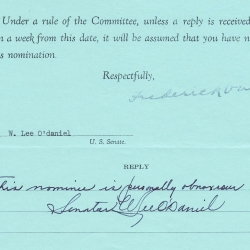
In its first decade, the Senate established the practice of senatorial courtesy in which senators expected to be consulted on all nominees to federal posts within their states and senators deferred to the wishes of a colleague who objected to an individual nominated to serve in his or her state. If a president insisted on nominating an individual without consultation with or over the objections of a senator, senators merely had to announce in committee or before the full Senate that a nominee was “personally obnoxious” or “personally objectionable” to them without any further explanation. They could depend on the deference of Senate colleagues in rejecting the nominee. While the custom of senatorial courtesy was firmly established by the late 19th century, senatorial objections did not always doom the nomination, especially if a senator was of the opposing party from the president or the Senate majority. In 1890, with Senate Republicans in the majority and Republican Benjamin Harrison in the White House, Judiciary Committee chairman George Edmunds used this form letter to solicit the opinion of Florida Democratic senator Wilkinson Call about the nomination of Charles Swayne to be U.S. District Judge for the Northern District of Florida. “I do not consider him to be qualified either mentally or morally for the office of judge,” Call replied. Despite Call’s objection, and the objection of his fellow Florida senator Samuel Pasco (also a Democrat), Swayne’s nomination cleared the Senate.
Blue Slip, Signed by Senator W. Lee O’Daniel, 1943
The Judiciary Committee formalized a version of senatorial courtesy through use of the “blue slip,” a blue sheet of paper on which a senator could register support for or opposition to a judicial nominee to serve in his or her state. The process has varied over the years, with different committee chairs giving varied weight to a negative or non-returned blue slip, but the system has endured, providing home-state senators the opportunity to be heard by the Judiciary Committee. During a nomination debate on the Senate floor in 1960, William Proxmire of Wisconsin called senatorial courtesy “the ultimate senatorial weapon,” a “nuclear warhead intercontinental ballistic missile of Senate nomination action.” While there have been changes to the rules and customs governing Senate advice and consent over the past half century—for example, senators no longer announce in the Senate Chamber that a nominee is “personally obnoxious” to them—individual senators continue to influence the nomination and confirmation process.
Hearings on the Nomination of Sandra Day O’Connor to be an Associate Justice of the Supreme Court of the United States, 1981
During the 20th century, Senate committees hired staff to handle nominations and formalized procedures and practices for scrutinizing nominees. In 1939 Felix Frankfurter became the first nominee to appear before the Judiciary Committee to answer questions in a public hearing, and Dean Acheson became the first nominee for secretary of state to testify in open session before the Foreign Relations Committee 10 years later. By the 1950s, committees began routinely holding public hearings and requiring nominees to appear in person. By the 1990s, Judiciary Committee staff included an investigator who worked on nominations. In 1981 Sandra Day O’Connor of Arizona appeared before the Judiciary Committee as the first woman nominated to the serve on the Supreme Court. O’Connor’s nomination hearing was the first to be televised, and today all committee nomination hearings are broadcast or live-streamed on the Internet.
Today, committees have the option of reporting a nominee to the full Senate with a recommendation to approve ("reported favorably"), with a recommendation to not approve ("reported adversely"), or with no recommendation. Reporting adversely—sometimes because senatorial courtesy was not observed—has become rare. Since the 1970s, committees have on occasion, though still infrequently, voted not to report a nominee to the full Senate, effectively killing the nomination. More frequently, committees do not act on nominations that do not have majority support to move forward.
Through its power of advice and consent on nominations, the Senate serves a pivotal role in the complex system of check and balances established by the framers of the Constitution in 1787. While the way in which the Senate has exercised that power has evolved over the course of its history, it has consistently fulfilled its constitutional responsibility of advice and consent, playing a role both in the selection and confirmation of nominees.
|
 | 202407 01100 Years Since Teapot Dome
July 01, 2024
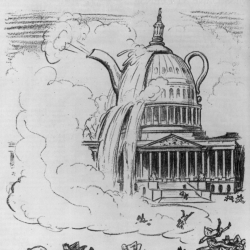
A century ago, in June 1924, the Senate Committee on Public Lands and Surveys released a report, Leases Upon Naval Oil Reserves, that outlined one of the worst breaches of the public trust in American history. The Senate investigation into the scandal, popularly known as Teapot Dome and led by Thomas J. Walsh of Montana, uncovered widespread corruption between government officials and powerful corporate interests. The inquiry serves as a powerful example of effective congressional oversight, highlighting the ability of lawmakers to expose wrongdoing to protect the public interest.
A century ago, in June 1924, the Senate Committee on Public Lands and Surveys released a report, Leases Upon Naval Oil Reserves, that outlined one of the worst breaches of the public trust in American history. The Senate investigation into the scandal, popularly known as Teapot Dome and led by Thomas J. Walsh of Montana, uncovered widespread corruption between government officials and powerful corporate interests. The inquiry serves as a powerful example of effective congressional oversight, highlighting the ability of lawmakers to expose wrongdoing to protect the public interest.
The seeds of the Teapot Dome scandal were planted in the first decade of the 20th century, when President Theodore Roosevelt and conservationists in Congress took steps to protect public lands from unlimited private exploitation. Concerned with ensuring the national government had access to energy resources and anticipating the conversion of the nation’s naval fleet from coal-burning to oil-burning power, Roosevelt instructed the U.S. Geological Survey to survey oil reservoirs beneath public lands. In 1909 President William Howard Taft responded to the Survey’s findings by signing an executive order withdrawing three million acres of public lands in California and Wyoming from private settlement and development and designating portions of these public lands in California, known as Elk Hills and Buena Vista, as naval oil reserves. In 1915 President Woodrow Wilson added a third naval oil reserve in Wyoming, named Teapot Dome after a sandstone rock formation that resembled a teapot. Congress by law in 1920 placed these reserves under the supervision of the secretary of the navy, who was given wide latitude “to conserve, develop, use, and operate the oil reserves” in the national interest.1
In the years after the reserves were created, the nation’s largest oil companies began plotting to obtain leases for drilling. The amount of oil in the reserves, and the money that could be made by extracting it, was staggering. Surveys estimated that the three reserves combined held 435 million barrels of oil, almost equal to the total amount of oil that had been produced in the country to that point. Extracted, those resources were estimated to be worth hundreds of millions of dollars, at least a billion in today’s dollars.2
In 1921 Secretary of the Interior Albert Fall was also keenly interested in the reserves. Fall was a former gold and silver prospector and attorney who had been elected to serve as one of New Mexico’s first senators in 1912. Known for his volatile personality and his frontiersman ways—he reportedly often carried a six-shooter pistol—Fall enjoyed the support of prominent industrialists who had helped finance his 1918 re-election campaign and provided backing for Fall’s purchase of a prominent Albuquerque newspaper. In the Senate, Fall became friends with fellow Republican senator Warren G. Harding of Ohio (who had joined the Senate in 1915), the two bonding over whiskey and poker games—then a popular Washington pastime. When Harding was elected president in 1920, he nominated Fall to be his secretary of the interior. Fall had plans to open the nation’s public lands to private development, and he persuaded the president to place the naval reserves under his control. On May 31, 1921, Harding signed an executive order transferring control of the naval reserves from the Navy Department to the Interior Department.3
Rumors swirled for months about Fall’s plans to develop the reserves. On April 12, 1922, Fall offered to his friend Harry F. Sinclair, the head of Sinclair Oil, an exclusive, no-bid lease for the Teapot Dome oil reserves. Intending to keep the deal a secret, Fall locked the contract in his desk and instructed the assistant secretary to tell no one about it. But intrepid reporters soon uncovered the story. On April 14, 1922, the Wall Street Journal ran a front-page exposé detailing the sweetheart deal. The Denver Post was not far behind, offering details about what it called “one of the baldest public land-grabs in history.”4
Independent oil producers saw the press coverage and, angry at not having had an opportunity to bid on the leases, complained to Wyoming Democratic senator John B. Kendrick about the secret negotiations of the Teapot Dome deal. When Kendrick inquired about the details of the lease from the Interior Department, Fall’s subordinates gave him the runaround. On April 15, Kendrick introduced a resolution in the Senate instructing the secretaries of the interior and the navy to inform the Senate about any ongoing negotiations for leases on Teapot Dome. Now under intense pressure, Fall released a statement to the press on April 18 announcing the Teapot Dome lease and disclosing the impending completion of another lease for the Elk Hills reserve to oil baron Edward Doheny and his Pan-American Oil Company. On April 20, Senator Robert La Follette of Wisconsin, a progressive Republican and a leading conservationist in the Senate, introduced a resolution demanding from the Interior Department all documents relating to the negotiation and execution of leases on the naval oil reserves. The Senate amended the resolution to authorize the Committee on Public Lands and Surveys to conduct a full-scale investigation and approved it by unanimous vote (with 38 senators not voting) a week later.5
In early June, Fall submitted to President Harding a 75-page report and thousands of supporting documents detailing the history of the naval oil reserves and the geological data that Fall claimed justified the leases. Harding sent the report to the Senate with a memo stating that all policies regarding the reserves had been reviewed by him and “at all times had my entire approval.”6
The Teapot Dome investigation was slow to get off the ground. The first challenge was getting someone to lead it. While La Follette had been the driving force to authorize the inquiry, he was not a member of the Committee on Public Lands. The Republican chair of the committee was Reed Smoot of Utah, a conservative who was not enthusiastic about pursuing an investigation that could be politically damaging for his party. John Kendrick served on the Public Lands Committee but did not want to take on the task. La Follette and Kendrick persuaded Democrat Thomas Walsh of Montana to lead the investigation.
The son of Irish Catholic immigrants, Walsh had been an attorney in Helena, Montana, before becoming a powerful force in the state’s Democratic Party. Elected to the Senate in 1912, Walsh had a reputation as an able lawyer and a progressive willing to take on the powerful mining interests in his state. Walsh was the most junior member of the minority party on the committee, but the ranking Democrat was leaving the Senate after 1922, and La Follette and Kendrick opted to bypass the other more senior Democrats. Walsh was not a conservationist and had, to that point, been a supporter of opening up public lands—and Native American reservations—for resource exploitation. He was initially reluctant to commit to the investigation, but after some prodding from fellow Montana Democrat Burton K. Wheeler, he agreed in June 1922 to wade in and began reviewing the mountain of documents submitted by Fall.7
Walsh worked through the evidence methodically throughout the summer and fall of 1922, and by early 1923, he began to suspect that Fall had engaged in misconduct. In February 1923, with the Senate set to adjourn in March, the Public Lands Committee set a hearing date for October, a little more than a month before the 68th Congress would convene in December. By the time Walsh returned to Washington in September to begin preparing for the hearing, Albert Fall had resigned from the cabinet to go work for Sinclair, President Harding had died of a heart attack, and Vice President Calvin Coolidge had become president.8
When the hearings began on October 23, 1923, the main question facing the committee was whether Albert Fall was justified in secretly leasing the naval reserves without competitive bidding. Chairman Smoot called the committee to order and then turned over the proceedings to Walsh, who took the lead in questioning witnesses. In the opening round of questioning, Walsh challenged Fall on the legality of Harding transferring control over the naval reserves to him as secretary of the interior and argued that Congress had clearly intended for the secretary of the navy to be the steward of its oil. Fall contended that the president was in his rights to give him responsibility over the reserves. He defended his quick action in granting leases as necessary to prevent the reserves from being depleted by drainage—the intentional depletion of reserves by adjacent landowners. Reports from the Bureau of Mines had indicated that drainage was not a concern, but geologists hired by the committee at the behest of Chairman Smoot disagreed, claiming that the reserves were draining at a rapid rate and that only 25 million barrels of oil remained. Under questioning, Fall defended his selection of Sinclair as a sound business decision and the deal’s secrecy as a matter of national security. Smoot opined that “if the reports of the experts are accepted, the theory that the government made a mistake in leasing this reserve has been exploded.”9
Walsh had other sources, however, that opened up new avenues of investigation. Journalists from Denver and New Mexico—including Carl Magee, who had purchased Fall’s newspaper from him in 1920—told Walsh about a suspicious, abrupt change in Fall’s personal finances. Brought before the committee on November 30, Magee testified that Fall had been cash-poor in 1921 and a decade in arrears on the property taxes of his dilapidated New Mexico ranch. But in June 1922 Fall, suddenly flush with cash, paid his back taxes, purchased neighboring properties, and made substantial improvements to his previously rundown ranch. The burning question became, where did Fall get all of this money?10
By the time Walsh completed his questioning of witnesses in January 1924, he had uncovered suspicious payments made to Fall. Harry Sinclair gave Fall $269,000 in Liberty Bonds and cash a month after signing the Teapot Dome lease. Edward Doheny, to whom Fall awarded the Elk Hills reserve lease, testified that he instructed his son to deliver $100,000 (well over $1 million in today’s money) in cash to Fall “in a little brown satchel,” allegedly as a loan, but one that Fall had lied about and tried to conceal from Walsh and the committee. In a closed committee meeting, Walsh informed his colleagues that he would be introducing a resolution directing the president to appoint a special counsel to bring civil suits to cancel the naval reserve leases and to pursue criminal charges connected to awarding the leases. Republican Irvine Lenroot, now chair of the Public Lands Committee, informed President Coolidge of Walsh’s intentions and urged him to get out in front of the news. On January 27 Coolidge announced his intent to appoint counsel and file charges, and a few days later the Senate passed Walsh’s resolution.11
Walsh was not done with his investigation, however. What had begun in late 1923 as a quiet set of hearings in a small committee room soon became a public sensation with audiences packed into the spacious Caucus Room on the third floor of the Senate Office Building. Walsh recalled Fall to face more questioning, but Fall delayed, claiming ill health. When he finally returned on February 2, 1924, Fall refused to answer any additional questions, claiming his Fifth Amendment right not to incriminate himself and further arguing that the imminent appointment of special prosecutors ended the committee’s authority over the case. When Sinclair came back for more questioning in March, he refused to answer questions as well, though he didn’t bother to cite his Fifth Amendment rights. “There is nothing in any of the facts or circumstances of the lease of Teapot Dome which does or can incriminate me,” he stated. The Senate referred contempt charges against both Fall and Sinclair to the District of Columbia courts.12
The Public Lands Committee concluded its hearings in May 1924, and a bipartisan majority issued its final report in June, signed by Edwin Ladd of North Dakota, who had become committee chair in March. Some senators and representatives, particularly Democrats, criticized the report for its lack of drama and its failure to draw conclusions about the corrupting influence of oil interests in government. Still, the report included additional evidence of corruption, including Sinclair’s payments to buy off rival claimants to the reserves, as well as a $1 million payment to newspaper publishers in exchange for their silence when they discovered the shady circumstances surrounding the Teapot Dome lease.13
The committee noted “rumors” of a broader conspiracy on the part of prominent oil companies to place Harding in the White House and Fall in the Interior Department for the very purpose of exploiting natural resources on public lands but concluded only that “the evidence failed to establish the existence of such a conspiracy.” Five Republicans on the committee, led by Smoot, issued a minority report complaining that the majority had not given them time to review the report and all the supporting evidence. In January 1925, a minority of the committee issued a more substantive report defending many aspects of the Harding administration’s handling of the naval reserves and criticizing Walsh for dedicating space in the report to what it saw as baseless rumors about political conspiracies. Historians who have dug into the scandal have since given these theories more credence.14
Civil and criminal litigation involving the oil reserve leases dragged on for the next six years, with several cases going before the Supreme Court. In the end, the government proved that the leases had been illegally obtained and successfully regained control of the naval reserves. Fall was found guilty of accepting a bribe from Sinclair and sentenced to a year in prison, the first cabinet official in U.S. history to be convicted of a felony. Juries acquitted Sinclair and Doheny on charges of conspiracy to defraud the government, however. Sinclair served prison time for contempt of court—he was found guilty of attempting to intimidate the jury in his criminal trial—and contempt of Congress. The Supreme Court heard his appeal, upheld his conviction, and recognized the Senate’s investigatory power and its authority to compel testimony from witnesses. In another contempt case arising out of a related investigation into Harding administration corruption, the Court held in the McGrain V. Daugherty decision, “We are of opinion that the power of inquiry—with process to enforce it, is an essential and appropriate auxiliary of the legislative function.”15
The Teapot Dome scandal cast a long shadow over American politics, for decades serving as a symbol of the highest form of government corruption. Lawmakers investigating charges of corruption in the decades that followed the scandal would inevitably make the comparison, warning the public that they may find evidence of “another Teapot Dome” or something “worse than Teapot Dome.” In 1950, commenting on the development of the western United States, President Harry Truman stated, “The name Teapot Dome stands as an everlasting symbol of the greed and privilege that underlay one philosophy about the West.” In 1973, as Watergate coverage flooded the national media, some reporters called it “the new Teapot Dome.” “For half a century, [Teapot Dome] has, for many Americans, represented the quintessence of corruption in government,” wrote one correspondent. “Now Teapot Dome has been shoved aside by contemporary events.”16
For the Senate, the Teapot Dome investigation firmly established the authority of Congress to question the executive branch and demand information about its operations. Senator Walsh’s diligent and tenacious search for the truth uncovered corruption and held the government accountable to the people it serves, setting a standard for future Senate investigations to emulate.
Notes
1. Hasia Diner, “The Teapot Dome Scandal, 1922–1924,” in Congress Investigates: A Critical and Documentary History, vol. 1, eds. Roger Bruns, David Hostetter, and Raymond Smock (Byrd Center for Legislative Studies, 2011), 460; Laton McCartney, The Teapot Dome Scandal: How Big Oil Bought the Harding Whitehouse and Tried to Steal the Country (New York: Random House, 2019), 28–29, 96.
2. Senate Committee on Public Lands and Surveys, Leases Upon Naval Oil Reserves: Hearings Pursuant to S. Res. 282, S. Res. 294, and S. Res. 434, 68th Cong., October 31, 1923, 678. Experts of the time disagreed as to how much oil was held in the reserves. The Bureau of Mines estimated that Teapot Dome held 135 million barrels of oil, for example, but geologists employed by the Committee on Public Lands estimated it at only 12 to 26 million. These estimates turned out to be very low. The Elk Hills reserve alone has yielded more than a billion barrels of oil in the century since. “Elk Hills Is Source of Controversy,” New York Times, April 1, 1975, 10.
3. David Hodges Stratton, Tempest Over Teapot Dome: The Story of Albert B. Fall (Tulsa: University of Oklahoma Press, 1998), 148–49; McCartney, Teapot Dome Scandal, 31–35, 65–67.
4. Quoted in McCartney, Teapot Dome Scandal, 127.
5. S. Res. 277, 67th Cong., 2nd sess., April 15, 1922; S. Res. 282, 67th Cong., 2nd sess., April 29, 1922; Congressional Record, 67th Cong., 2nd sess., April 29, 1922, 6092–97.
6. Naval Reserve Oil Leases, Message from the President of the United States, S. Doc. 67-210, 67th Cong., 2nd sess., June 8, 1922.
7. J. Leonard Bates, Senator Thomas J. Walsh: Law and Public Affairs from TR to FDR (Champaign, IL: University of Illinois Press, 1999), 201–11; McCartney, Teapot Dome Scandal, 160.
8. Bates, Senator Thomas J. Walsh, 210–11.
9. Leases Upon Naval Oil Reserves, Hearings, October 23, 24, 1923, 175–282; “Experts Uphold Teapot Dome Lease,” New York Times, October 23, 1923, 23, quoted in McCartney, Teapot Dome Scandal, 171.
10. Diner, “The Teapot Dome Scandal, 1922–1924,” 464; Leases Upon Naval Oil Reserves, Hearings, November 30, 1923, 830–43.
11. Leases Upon Naval Oil Reserves, Hearings, January 24, 1924, 1772; Diner, “The Teapot Dome Scandal, 1922–1924,” 466–68; Joint Resolution Directing the President to institute and prosecute suits to cancel certain leases of oil lands and incidental contracts, and for other purposes, Public Resolution 68–4, 68th Cong., 1st sess., February 3, 1924, 43 Stat. 5.
12. Leases Upon Naval Oil Reserves, Hearings, February 2, 1924, 1961–63; March 22, 1924, 2894; Congressional Record, 68th Cong., 1st sess., March 24, 1924, 4790–91.
13. Senate Committee on Public Lands and Surveys, Leases Upon Naval Oil Reserves, S. Rep. 68-794, 68th Cong., 1st sess., Parts 1 and 2, June 6, 1924.
14. Leases Upon Naval Oil Reserves, S. Rep. 68-794, Part 2, June 6, 1924 and Part 3, January 15, 1925; McCartney, Teapot Dome Scandal, 1–73.
15. McGrain v. Daugherty, 273 U.S. 135, 174 (1927); Jake Kobrick, “United States v. Albert B. Fall: The Teapot Dome Scandal,” Federal Judicial Center, accessed June 26, 2024, https://www.fjc.gov/history/cases/famous-federal-trials/us-v-albert-b-fall-teapot-dome-scandal.
16. “Teapot Dome Likeness Seen in Radio Lobby,” Washington Post, January 12, 1937, 24; “War Assets Scandal Seen,” Baltimore Sun, June 19, 1946, 4; “Power Pact Likened to Teapot Dome,” Baltimore Sun, July 11, 1955, 1; “Pledge Given by Truman to Develop West,” Los Angeles Times, May 10, 1950, 1; “Watergate Joins Teapot Dome in US Scandal Vocabulary,” Christian Science Monitor, May 9, 1973, 7; Lee Roderick and Stephen Stathis, “Today Watergate—Yesterday Teapot Dome,” Christian Science Monitor, July 17, 1973, 9.
|
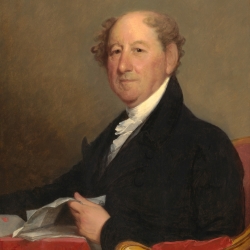 | 202309 15Constitution Day 2023: The Senate’s Last Framer—Rufus King
September 15, 2023
Of the 55 delegates who attended the Constitutional Convention in Philadelphia during the summer of 1787, 19 later served in the U.S. Senate, including New York senator Rufus King. Like other consequential individuals whose participation in America’s founding crossed over into the new federal republic, King’s experience as a framer later informed his efforts to implement the Constitution as a member of Congress. King served in the Senate longer than any other delegate to the Philadelphia convention—the Senate’s last framer—and became a respected and often outspoken elder statesman.
Of the 55 delegates who attended the Constitutional Convention in Philadelphia during the summer of 1787, 19 of those constitutional framers later served in the U.S. Senate, including New York senator Rufus King. Like other consequential individuals whose participation in America’s founding crossed over into the new federal republic, King’s experience as a framer later informed his efforts to implement the Constitution as a member of Congress, bringing knowledge, continuity, and stability to the new government. A member of the Massachusetts delegation to the Constitutional Convention, King subsequently moved to New York and became one of the first two senators to represent that state in 1789. He went on to serve in the Senate longer than any other delegate to the Philadelphia convention—the Senate’s last framer—and became a respected and often outspoken elder statesman.
As historians have explained, the individuals chosen to attend the federal convention that resulted in the creation of a “partly federal and partly national” constitutional system “were not mere ‘theoretical’ politicians who were engaging in government for the first time.” They “were experienced veterans, many of whom had already been able to see the variants of democracy play out within their own states,” while others “knew firsthand the frustrations of governing” under the Articles of Confederation that preceded the constitutional government. This was certainly true of Rufus King.1
Just 32 years old when he attended the Constitutional Convention in 1787, King was already considered, as described by fellow delegate William Pierce of Georgia, a “man much distinguished for his eloquence and great parliamentary talents,” who “ranked among the Luminaries of the present Age.” Trained as a lawyer, he entered Massachusetts politics with service in the state’s general assembly before becoming a delegate to the Continental Congress. Taking leave of his post to attend the Philadelphia convention, King was present at every session and took notes—a valuable resource for historians. Considered “among the most capable orators” at the convention, his contributions were significant. He served on several major committees, including the important Committee on Postponed Matters and Committee of Style, which were charged with finalizing the document as the convention was ending. As historian Richard Welch concluded, King was “surely one of the most prominent members of the Convention at large.”2
After the ratification of the Constitution, when the First Congress convened in 1789, the 34-year-old King became the youngest senator of the time. King “came to the Senate with a record of solid achievement,” historian Roy Swanstrom explained, and he “was consistently among the most active Senators in committee work.” During his first Senate term, King played a key role in the creation and approval of the Jay Treaty, co-authoring with Secretary of the Treasury Alexander Hamilton and Chief Justice of the United States John Jay a series of published essays in defense of the controversial treaty with Great Britain. He also proved influential in establishing the First Bank of the United States and was elected one of the first 25 directors of the bank in 1791.3
In 1796 President George Washington appointed King to be minister to Great Britain, a position he held until 1803. Upon his return to the United States, King spent a decade out of public office before again being elected to the Senate in 1813. By this time, King was the “only senator who had sat in the body while Washington was President,” and was one of only two framers still serving in the Senate—along with New Hampshire’s Nicolas Gilman. When Gilman died in 1814, King became the last framer of the Constitution still serving in the Senate.4
Specializing in matters of finance and foreign relations, as well as maritime law, commerce, and public lands, King’s expertise was widely respected by his contemporaries. His skillful oratory often impressed his congressional colleagues, including a young, newly elected New Hampshire representative named Daniel Webster, who hailed King’s speaking ability as “unequalled.” When the Senate established its standing committee system in 1816, King was assigned to two of the most important panels—Foreign Relations and Finance. “In the years to come he would apply his knowledge and experience” to that committee work, noted a biographer, and “in debates and roll calls on the Senate floor, he was a watchdog, sniffling out signs of wastefulness and partisan aims.”5
By the time the Senate tackled the difficult issue of the Missouri crisis in 1819 and 1820, King was a respected elder statesman. His status was tested, however, when the question of expanding slavery in new western states threatened to disrupt the delicate balance between slave states and free states, especially in the Senate, where states were given equal representation. King insisted that Congress had a right to exclude slavery from new states. This position alienated colleagues of slaveholding states but bolstered support in the northern states. King’s speeches rallied opposition to the proposed compromise that sought to admit Missouri as a slave state and Maine as a free state while prohibiting slavery in the territories north of the 36º 30' parallel.
King had consistently opposed the expansion of slavery throughout his career. While serving in the Continental Congress in the 1780s, he had introduced a resolution providing that there should be neither "slavery nor involuntary servitude" in the Northwest Territory, language that was ultimately incorporated into the Northwest Ordinance of 1787. During the Constitutional Convention, foreseeing the growing divide between slave and free states, he had expressed doubts about the three-fifths compromise that determined the method by which enslaved Americans were to be counted for purposes of taxation and representation. Although King had accepted the three-fifths compromise as a necessary concession to slaveholding states in order to gain adoption of the Constitution, by 1803, when the purchase of the vast Louisiana Territory raised new possibilities for the expansion of slavery, he believed that the three-fifths provision was one of the “greatest blemishes” on the Constitution.6
In 1819, as senators debated the issue of expanding slavery into Missouri and other western states, King stood in opposition, drawing on his participation in the constitutional debate over the three-fifths compromise to frame his argument. “The equality of rights, which includes an equality of burdens, is a vital principle in our theory of government,” he explained, “and its jealous preservation is the best security of public and individual freedom.” He maintained that “the departure from this principle in the disproportionate power and influence, allowed to the slave holding states” through the three-fifths compromise, “was a necessary sacrifice to the establishment of the constitution,” but such a compromise was no longer acceptable. “The effect of this concession has been obvious in the preponderance which it has given to the slave holding states over the other states.” He continued:
Nevertheless it is an ancient settlement, and faith and honour stand pledged not to disturb it. But the extension of this disproportionate power to the new states would be unjust and odious. The states whose power would be abridged, and whose burdens would be increased by the measure, cannot be expected to consent to it; and we may hope that the other states are too magnanimous to insist on it.7
King’s Senate speeches were printed and distributed as a pamphlet, fueling the already heated debate over slavery’s possible westward expansion. Given King’s status as a veteran statesman, the publication received much attention. According to historian Robert Ernst, “The speeches became a center of acrimonious controversy.” The pamphlet “has largely contributed to kindle the flame now raging throughout the Union on that question, and which threatens its dissolution,” John Quincy Adams (then serving as Secretary of State) wrote in his diary. “A whirlwind of anti-Missouri feeling swept over the North,” noted historian Homer Hockett. “Mass meetings were held and resolutions passed in open opposition to the extension of slavery into the new states,” commented historian Joseph L. Arbena, who wrote that “King appeared to be the source of much of this agitation.” His speeches and “ideas formed the bases for many of the essays, memorials, and speeches presented in support of his stand.” Observing King’s influence over the Missouri debate, Boston journalist and author William Tudor wrote to King in February 1820: “I have been convinced that it is chiefly owing to you that the nation has been awakened to examine its consequences.” Describing King’s fervor in the Missouri debate, Adams concluded, “King has made a desperate plunge into it, and has thrown his last stake upon the card.”8
While King’s speeches strengthened the opposition to the Missouri Compromise, they also stirred suspicions about the veteran senator’s motives. Critics, particularly those in favor of the compromise, accused King of using the crisis for his own political gain and to realign the parties around the issue and establish himself as a leader of a new party. Adams rejected such notions, arguing, “There is not a man in the Union of purer integrity than Rufus King.” Historians have tended to agree with Adams. “Although he would have welcomed a new political alignment of northern Republicans and the few remaining Federalists,” wrote Ernst, “there is no credible evidence that he plotted to bring this about, nor was he motivated by personal ambition for power.” Nevertheless, the suspicions cast upon King’s motives aided in diminishing the effectiveness of his influence upon the debate, contributing to the ultimate failure of his position.9
Despite the controversies of the Missouri crisis, King remained a respected and trusted public figure. In 1821 the Senate elected him as chairman of the influential Foreign Relations Committee—despite the fact that he was in the minority party, one of only four remaining Federalists in the Senate. Even those who had been disappointed by King’s position in the Missouri debate continued to hold him in high esteem. One admirer, Virginia representative John Randolph, remarked, “Ah, sir! only for that unfortunate vote on the Missouri Question, he would be our man for the Presidency. He is, Sir, a genuine English gentleman of the old school, just the right man for these degenerate times; but, alas! it cannot be.”10
King was both an ardent Federalist and an esteemed national leader whose link with the past, and particularly to his role as constitutional framer, garnered an admiration that eclipsed partisanship. “A venerable Senator, he was a sort of ‘Mr. Federalist,’" Ernst observed. Even as the Federalist influence declined, Ernst continued, “Rufus King's reputation as an elder statesman brightened.” His service in the Senate, which continued until 1825, extended well beyond any of the other 19 delegates to the Constitutional Convention who later became senators. A Massachusetts colleague, Harrison G. Otis, assessed the importance of King’s continuing service. “You prevent a great deal of mischief and keep in check the framers of crude projects and cunning devices,” Otis stated to King in 1823, adding, “whoever writes your epitaph…may be able to say that you continued many years at your post, the last of the Romans.” Rufus King, elder statesman, was the Senate’s last framer.11
Notes
1. John R. Vile, The Men Who Made the Constitution: Lives of the Delegates to the Constitutional Convention of 1787 (Lanham: Scarecrow Press, Inc., 2013), xx; David O. Stewart, The Summer of 1787: The Men Who Invented the Constitution (New York: Simon & Schuster, 2007), 25.
2. “Notes of Major William Pierce on the Federal Convention of 1787,” The American Historical Review 3, no. 2 (January 1898): 325; National Park Service, Signers of the Constitution: Historic Places Commemorating the Signing of the Constitution (Washington, DC: U.S. Government Printing Office, 1976), 180–81; Richard E. Welch, Jr., “Rufus King of Newburyport: The Formative Years (1767–1788),” Essex Institute Historical Collections 96, no. 4 (October 1960): 267.
3. Roy Swanstrom, The United States Senate 1787–1801: A Dissertation on the First Fourteen Years of the Upper Legislative Body, reprinted as S. Doc. 99-19, 99th Cong., 1st sess. (Washington, DC: Government Printing Office, 1985), 45, 271–72.
4. Robert Ernst, Rufus King: American Federalist (Chapel Hill: University of North Carolina Press, 1968), 322.
5. Ernst, Rufus King, 327, 353.
6. Welch, Jr., “Rufus King of Newburyport,” 248; Joseph L. Arbena, “Politics or Principle? Rufus King and the Opposition to Slavery, 1785–1825,” Essex Institute Historical Collections 101, no. 1 (January 1965): 64–65; Robert Ernst, “Rufus King, Slavery, and the Missouri Crisis,” The New York Historical Society Quarterly 46, no. 4 (October 1962): 364.
7. Rufus King, The Substance of Two Speeches, Delivered in the Senate of the United States, on the Subject of the Missouri Bill, (Philadelphia: Clark & Raser, printers, 1819), 6–7, Library of Congress collection, accessed on August 29, 2023, https://www.loc.gov/item/09020866/.
8. Ernst, “Rufus King, Slavery, and the Missouri Crisis,” 367; Charles F. Adams, ed., Memoirs of John Quincy Adams, Comprising Portions of His Diary from 1795 to 1848 (Philadelphia: J.B. Lippincott & Co., 1875), vol. 4, 517, 526; Homer C. Hockett, "Rufus King and the Missouri Compromise,'' Missouri Historical Review 2 (April 1908): 216; Arbena, “Politics or Principle?” 72; Charles R. King, ed., The Life and Correspondence of Rufus King: Comprising His Letters, Private and Official, His Public Documents and His Speeches (New York: G.P. Putnam’s Sons, 1900), vol. 6, 272.
9. Adams, Memoirs of John Quincy Adams, vol. 5, 13; Ernst, “Rufus King, Slavery, and the Missouri Crisis,” 382.
10. Ernst, Rufus King, 384–85; William Cabell Bruce, John Randolph of Roanoke, 1773–1833: A Biography Based Largely on New Material (New York: G.P. Putnam’s Sons, 1922), 612.
11. Ernst, “Rufus King, Slavery, and the Missouri Crisis,” 373–74; Ernst, Rufus King, 407–9.
|
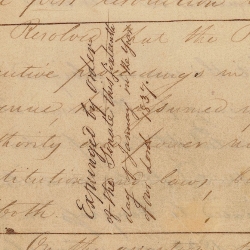 | 202304 04Treasures from the Senate Archives: Legislative-Executive Relations
April 04, 2023
Each year, during the first week of April, the Senate commemorates “Congress Week.” Tied to the date when the Senate established a quorum for the first time—April 6, 1789—Congress Week is an annual reminder of the importance of saving and preserving the records of Congress, including the selection of historic records featured in this month’s “Senate Stories,” which highlight the complex relationship between the Senate and the president.
Each year, during the first week of April, the Senate commemorates “Congress Week.” Tied to the date when the Senate established a quorum for the first time—April 6, 1789—Congress Week is an annual reminder of the importance of saving and preserving the records of Congress, including the selection of historic records featured in this month’s “Senate Stories,” which highlight the complex relationship between the Senate and the president.
Among the foundational principles of the U.S. Constitution is the separation of powers. In establishing three distinct branches of government—legislative, executive, and judicial—the Constitution divides authority to create the law, implement and enforce the law, and interpret the law. At the same time, many powers exercised by one branch may be shared with another. This system of checks and balances invites both compromise and conflict among the branches, especially between the legislative and executive, and prevents the consolidation of power in any single branch. For example, the Senate’s “advice and consent” is required for executive functions such as nominations and treaties. Conversely, the president has the power to veto legislation; however, Congress may overturn the veto with a two-thirds majority of those present and voting in both houses.1
The constitutional structure that provides for checks and balances is expansive and complex by design, generating an interdependence between the Senate and the executive branch that, combined with transient political interests, has historically demonstrated moments of high conflict as well as examples of great cooperation. This collection of historic documents from the Senate’s archives highlights the collaborations and the struggles that have defined the relationship between the Senate and the president. Each document, while capturing a specific moment in time with unique political conditions at play, also provides a broader view of the constitutional system of government in action, specifically the foundational principle of separation of powers and the complex system of checks and balances.
George Washington's First Inaugural Address, 1789
When George Washington was sworn in as the first president of the United States on April 30, 1789, he delivered this address to a joint session of Congress, assembled in the Senate Chamber in New York City’s Federal Hall. While this first occasion was not the public event we have come to expect, Washington's speech nevertheless established the enduring tradition of presidential inaugural addresses. Early presidential messages, including inaugural addresses and annual messages (now known as State of the Union addresses), are included in Senate records at the National Archives.
Although noting his constitutional directive as president "to recommend to your consideration such measures as he shall judge necessary and expedient," Washington refrained from detailing his policy preferences regarding legislation. Rather, on the occasion of his inaugural, he stated his confidence in the abilities of the legislators, insisting, "It will be…far more congenial with the feelings which actuate me, to substitute, in place of a recommendation of particular measures, the tribute that is due to the talents, the rectitude, and the patriotism which adorn the characters selected to devise and adopt them."
Message from President Thomas Jefferson to Congress Regarding the Louisiana Purchase, 1804
Treaty powers are among those shared by the president and the Senate. The Constitution provides that the president "shall have Power, by and with the Advice and Consent of the Senate, to make Treaties, provided two-thirds of the Senators present concur" (Article II, section 2). In 1803 President Thomas Jefferson's administration negotiated a treaty with France by which the United States purchased the vast Louisiana Territory. Questions arose concerning the constitutionality of the purchase, but Jefferson and his supporters successfully justified the legality of the acquisition. On October 20, 1803, the Senate approved the treaty for ratification by a vote of 24 to 7. The territory, which encompassed more than 800,000 square miles of land, now makes up 15 states stretching from Louisiana to Montana. In this congratulatory message to Congress dated January 16, 1804, President Jefferson reported on the formal transfer of the land to the United States and referenced the December 20, 1803, proclamation announcing to the residents of the territory the transfer of national authority.
Page from the Senate Journal Showing the Expungement of a Resolution to Censure President Andrew Jackson, 1834
The March 28, 1834, censure of President Andrew Jackson represents a notably contentious episode in the executive-legislative relationship. For two years, Democratic president Andrew Jackson had clashed with Senator Henry Clay and his allies over the congressionally chartered Bank of the United States. The dispute came to a head when President Jackson, who had opposed the creation of the Bank, ordered the removal of federal deposits from the Bank to be distributed to several state banks. When his first Treasury secretary refused to do so, Jackson fired him during a Senate recess and appointed a new Treasury secretary, who carried out his orders. Senator Clay and his allies, who supported the Bank, believed that President Jackson did not have the constitutional authority to take such action, and they found the explanation given for moving the federal deposits “unsatisfactory and insufficient.” Clay introduced the resolution to censure the president, charging that Jackson had “assumed the exercise of a power over the Treasury of the United States not granted him by the Constitution and laws.” After extensive debate, the censure resolution passed. Jackson responded by submitting to the Senate a 100-page message arguing that the Senate did not have the authority to censure the president. The Senate again rebuffed the president by refusing to print the lengthy message in its Journal.2
Over the next three years, Missouri Democrat and Jackson ally Thomas Hart Benton campaigned to expunge the censure resolution from the Senate Journal. In January 1837, after Democrats regained the majority in the Senate, Senator Benton succeeded. On January 16, the secretary of the Senate carried the 1834 Journal into the Senate Chamber, drew careful lines around the text of the censure resolution, and wrote, “Expunged by order of the Senate."
President Abraham Lincoln's Nomination of Ulysses S. Grant to be Lieutenant General of the U.S. Army, 1864
Like treaty powers, the Constitution requires that the Senate serve as a check on the president's nomination authority. The president nominates federal judges, members of the cabinet, and military officials, among others, whose nominations are confirmed with the advice and consent of the Senate. This remarkable document dated February 29, 1864, representing a critical moment in the Civil War, is President Abraham Lincoln's nomination of Ulysses S. Grant to be lieutenant general of the U.S. Army, at the time the United States’ highest military rank. Previously, only two men had achieved that rank—George Washington and Winfield Scott—and Scott’s had been a brevet promotion. To facilitate Grant’s nomination and ensure his superior status among military officers, Congress passed a bill to revive the grade of lieutenant general and authorize the president "to appoint, by and with the advice and consent of the Senate, a lieutenant-general, to be selected among those officers in the military service of the United States . . . most distinguished for courage, skill, and ability." The Senate confirmed Lincoln's nomination of Grant on March 2, 1864.
Letter from President Woodrow Wilson to Senator Henry Cabot Lodge, 1919
A unique event in legislative-executive relations occurred on August 19, 1919, when President Woodrow Wilson offered testimony before the Senate Committee on Foreign Relations on the Treaty of Versailles, then under consideration by the committee. The meeting, convened in the East Room of the White House, stood “in contradiction of the precedents of more than a century,” the Atlanta Constitution reported, noting the rarity of a president offering testimony before a congressional committee.3
The Treaty of Versailles ended military actions against Germany in World War I and created the League of Nations, an international organization designed to prevent another world war. President Wilson had led the U.S. delegation to the Paris Peace Conference in 1919 and had been a principal architect of the treaty. For months, Senate Foreign Relations Committee chairman Henry Cabot Lodge had encouraged the president to seek the advice of the Senate while negotiating the treaty’s terms, but Wilson chose to negotiate on his own. Personally invested in the treaty’s adoption, the president hand-delivered it to the Senate on July 10, 1919, and urged its approval for ratification in an unusual speech before the full Senate.
Under Senate rules, the treaty went to the Foreign Relations Committee for consideration, which held public hearings from July 31 to September 12, 1919. Among the most vocal critics of the proposed treaty was Lodge, who was also the Senate majority leader. Lodge opposed several elements of the treaty, particularly those related to U.S. participation in the League of Nations. On behalf of the Foreign Relations Committee, Lodge asked Wilson to meet with the committee to answer senators’ questions. With this letter, President Wilson agreed to Lodge's request and proposed the August 19 date at the White House.
Ultimately, Lodge’s committee insisted on a number of “reservations” to the treaty, but Wilson and Senate proponents of the treaty were unwilling to compromise on terms. Consequently, on November 19, 1919, for the first time in its history, the Senate rejected a peace treaty.
Attempted Override of President Richard Nixon's Veto of S. 518, 1973
Under the Constitution, the president is permitted to veto legislative acts, but Congress has the authority to override presidential vetoes by two-thirds majorities of both houses. This document provides a comprehensive example of these constitutional checks and balances in action. In 1973 Congress passed S.518, which sought to abolish the offices of the director and deputy director of the Office of Management and Budget and reestablish those positions with a new requirement that they be confirmed by the U.S. Senate. The bill’s proponents argued that because these positions had evolved to wield significant power, they ought to be subject to Senate confirmation.
President Richard Nixon vetoed the bill on May 18, claiming it to be unconstitutional. “This step would be a grave violation of the fundamental doctrine of separation of powers,” Nixon stated. While the Senate achieved the necessary two-thirds majority to override the veto, the House did not, and Nixon’s veto was sustained. Congressional efforts to override Nixon’s veto were recorded by the secretary of the Senate and clerk of the House of Representatives on the reverse side of the bill.
The system of checks and balances set forth by the Constitution is a complex one, creating a legislative-executive relationship that is sometimes adversarial and at other times cooperative, but always interdependent. Illustrating the Senate's broad-ranging responsibilities and the integral role the Senate has played in this constitutional system, these treasured documents from the Senate’s archives help us to gain a better understanding of the conflicts and compromises that have historically defined the relationship between the Senate and the president.
Notes
1. Matthew E. Glassman, "Separation of Powers: An Overview," Congressional Research Service, R44334, updated January 8, 2016, 2.
2. Senate Journal, 25th Cong., 2nd sess., March 28, 1834, 197.
3. “Wilson Meets Senators in Wordy Duel,” Atlanta Constitution, August 20, 1919, 1.
|
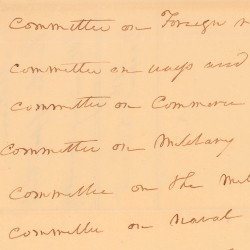 | 202204 04Treasures from the Senate Archives
April 04, 2022
Each year, during the first week of April, the Senate commemorates “Congress Week.” Tied to the date when the Senate established a quorum for the first time—April 6, 1789—Congress Week is an annual reminder of the importance of saving and preserving the records of Congress, including the historic records of Senate committees highlighted in this month's “Senate Stories.”
Each year, during the first week of April, the Senate commemorates “Congress Week.” Tied to the date when the Senate established a quorum for the first time—April 6, 1789—Congress Week is an annual reminder of the importance of saving and preserving the records of Congress, including the historic records of Senate committees highlighted in this month's “Senate Stories.”
In December 1816, the Senate established its first permanent standing committees. Prior to that time, the Senate had relied on ad hoc or temporary committees to sift and refine legislative proposals, to consider nominations and treaties, and to fulfill other constitutionally designated rights and responsibilities. The demands of a growing nation and a war with Great Britain prompted the Senate to revise its procedures. On December 10, 1816, senators approved a resolution to establish 11 permanent standing committees with jurisdictions over designated areas such as finance, foreign relations, military affairs, commerce, and the judiciary.
The records of these early ad hoc and standing committees, and all subsequent committees, represent the majority of official Senate records preserved and housed at the Center for Legislative Archives at the National Archives and Records Administration. This large collection of archived Senate committee records offers ample evidence of the important work done by each committee.
The Center for Legislative Archives preserves the oldest and most historically significant congressional records in its Treasure Vault, including records created during the First Congress, which convened in 1789. Along with the first Senate Journals, there are bills, war and censure resolutions, petitions, presidential messages, nominations, and proposed constitutional amendments. The simple, handwritten 1816 resolution creating the standing committees is among these precious documents. The fact that these documents were gathered and preserved long before the creation of the federal archives system makes their survival all the more extraordinary.
The following Senate documents from the Treasure Vault highlight the work of three of the Senate's original standing committees: Pensions, Commerce and Manufactures, and Judiciary. Each document captures a moment in time while providing a window into the operation of Senate committees as constitutional government-in-action.
Petition from Mary Colcord, 32nd Congress (1852)
In 1818 Congress passed a pension bill to provide financial support to Revolutionary War veterans. The oversight of this support (sometimes the only form of income for veterans and their families) was managed by the Committee on Pensions, one of the standing committees created in 1816. The committee’s archival records include applications like this one submitted to the Senate in 1852 by 81-year-old Mary Colcord. To document the service of her father, Bradstreet Wiggin, during the Revolutionary War, Colcord submitted the handwritten diary of Samuel Leavitt, a contemporary of her father from the same New Hampshire town who had served in the same company. The diary records Leavitt's service in the New Hampshire militia in 1780. It was given to the committee by Colcord presumably as evidence of her father's service, although she indicates that her father served during a different year. Consequently, the Senate’s archival collection has been enriched by this rare and historic record detailing a common soldier’s experience during the Revolutionary War. Although Colcord's claim, submitted more than 70 years after the war ended, was ultimately rejected by the committee, Congress did continue to pay Revolutionary War pensions as late as 1906.1
Following a congressional reorganization in 1946, the Senate moved the management of all war pensions to the Committee on Finance. In 1970 the Senate formed a Committee on Veterans Affairs and consolidated the oversight of all veterans’ issues, including pensions, under the jurisdiction of the new committee.
Memorial of Inhabitants of Los Angeles County, California, praying for establishment of a port of entry in that county, 31st Congress (1850)
The importance of commerce in national affairs led to creation of the Committee on Commerce and Manufactures in 1816. Regulating commerce is an expressed congressional responsibility, so it is not surprising to find among the committee’s papers this memorial, a form of petition, of the residents of Los Angeles County, California, part of the newly acquired Mexican Cession region, asking for the establishment of a port of entry in that county. This document, dated July 1850, was referred to the Commerce Committee amidst the debate over the Compromise of 1850, which resulted in establishing statehood for California that same year. Rapid progress in technology, communication, and commercial development in the 19th and 20th centuries prompted the Commerce Committee to split into various smaller committees to handle an ever-expanding legislative and oversight caseload. Two legislative reorganizations, in the 1940s and 1970s, consolidated most of these committees under the jurisdiction of today’s Senate Committee on Commerce, Science, and Transportation.
President Franklin D. Roosevelt’s message regarding national health, 76th Congress (1939)
On January 23, 1939, President Franklin D. Roosevelt sent a four-page presidential message to Congress calling for the creation of a “national health program … to make available in all parts of our country and for all groups of our people the scientific knowledge and skill at our command to prevent and care for sickness and disability.” Presidential messages, including the annual State of the Union Address, serve as vehicles for the president to raise urgent matters with Congress. The subjects of public health and health care assistance reflect the expansion of the role of the federal government in response to the national crisis of the Great Depression. Perhaps because of the references to science and economic loss, as well as the interstate nature of the proposed program, the message was referred to the Committee on Commerce.
Petition from Elizabeth Cady Stanton, Susan B. Anthony, and others, 42nd Congress (1871)
The First Amendment grants individuals the right to petition Congress to redress grievances or to seek the assistance of the government. Petitions allow ordinary citizens to express their views to their elected representatives. Managing these petitions became the responsibility of Senate committees, including the Judiciary Committee, which was established as a permanent committee in 1816 to oversee the courts, judicial proceedings, and constitutional matters. This petition is typical of thousands received by the committee supporting woman suffrage. It is particularly noteworthy because it includes the signatures of leading suffragists Elizabeth Cady Stanton and Susan B. Anthony who ask that they “be permitted in person, and on behalf of the thousands of other women who are petitioning Congress … to be heard … before the Senate and House.” Suffragists first testified before a Senate committee in 1878 and continued to do so until the Senate passed the Nineteenth Amendment in 1919, which granted female suffrage upon ratification in 1920.
President Lyndon B. Johnson's nomination of Thurgood Marshall to be associate justice of the Supreme Court, 90th Congress (1967)
The Senate has the constitutional power to advise and consent on presidential nominations, and Senate committees play an important role in that process. Before the 1860s, the Senate considered most nominations without referring them to a committee for review or investigation, although the Judiciary Committee did consider some nominees as early as the 1830s. In 1868 the Senate adopted rules to provide for more routine referral of nominations to "appropriate committees," but investigations of judicial nominees were rare. By the early 20th century, the Judiciary Committee had become much more integral to the nomination process, and by the mid-to-late 20th century, nominees were regularly testifying before the committee. This featured record of the Judiciary Committee, President Lyndon B. Johnson's 1967 nomination of Thurgood Marshall to be an associate justice of the U.S. Supreme Court, documents the historic appointment of the first African American Supreme Court justice.
First Issue of MAD magazine, from the investigative files of the Subcommittee on Juvenile Delinquency, 82nd Congress (1952)
The creation of standing committees enabled the Senate to better pursue its implied constitutional powers of oversight and investigation to inform legislation or to bring attention to important matters. Since World War II, congressional investigations into allegations of wrongdoing, fiscal mismanagement, national security, corporate malpractice, and social and economic issues of concern have resulted in better legislation, taxpayer savings, consumer protections, and stronger ethics laws. In most cases, standing committees serve as the Senate's principal investigative arm, but the Senate also has entrusted this responsibility to special and select committees.
The broad and extensive nature of these investigations has created an archival record that includes an interesting and unusual assortment of documents and artifacts. Among these is a collection of early 1950s comic books and youth publications, including 12 of the first 13 issues of MAD magazine. Popular films like Nicholas Ray’s 1955 Rebel Without a Cause dramatized public concern about wayward youths and juvenile violence, prompting a subcommittee of the Judiciary Committee to launch an inquiry. That investigation explored the role of popular culture, including publications like MAD magazine, in shaping adolescent behaviors and attitudes. The subcommittee continued to investigate the issue of juvenile delinquency for many years.
Illinois senator Everett M. Dirksen once remarked that “floor debate on a bill can be likened to an iceberg…the top shows, but the major part is underneath. The work of the committee is the large part that is not seen by the public.”2 The archived records of Senate committees reflect the behind-the-scenes work of senators and staff. They demonstrate the routine, the historical, the touchingly personal, and even the whimsical nature of committee work. Through these records we gain a better understanding of the history of the Senate and the ever-evolving work of Congress.
Notes
1. History of the Finance Committee, United States Senate, S. Doc. 97-5, 97th Cong., 1st sess., 1981, 47.
2. "What a United States Senator Does, by Senator Everett McKinley Dirksen, Republican Minority Leader," undated, included in the biographical files of the Senate Historical Office.
|
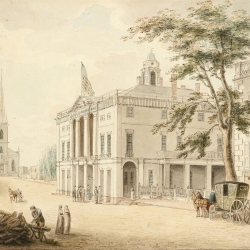 | 202209 17Constitution Day 2022: Treatymaking Power and George Washington's Visit to the Senate
September 17, 2022
The Constitution states that the president "shall have Power, by and with the Advice and Consent of the Senate, to make Treaties, provided two thirds of the Senators present concur." This defines how consent is given but does not explain how the Senate offers its advice. Many framers envisioned the Senate as an executive council that would discuss a treaty with the president as it was being negotiated. When President George Washington visited the Senate for that purpose in 1789, however, it became clear that the framers’ view might not prevail.
Constitutional Foundations of Treatymaking
When the framers of the Constitution considered the question of treatymaking at the Federal Convention held in Philadelphia in 1787, they originally proposed giving the Senate the sole power to make treaties. As the debate ensued, however, objections arose to depositing the full scope of this complex diplomatic power within the legislative branch. Ultimately, the framers decided that treatymaking would be a concurrent power, shared by the executive and the legislative branches. Article II, section 2 of the Constitution states that the president "shall have Power, by and with the Advice and Consent of the Senate, to make Treaties, provided two thirds of the Senators present concur."
In this shared responsibility, the Senate would check presidential power, give the president the benefit of its advice and counsel, and safeguard the sovereignty of the states by providing each state with an equal vote in the treatymaking process. The president would represent the national interest in treatymaking and allow for unity and efficiency. As Alexander Hamilton explained in Federalist, No. 75, the treatymaking power “seems…to form a distinct department, and to belong properly neither to the legislative nor to the executive. The qualities elsewhere detailed, as indispensable in the management of foreign negotiations, point out the executive as the most fit agent in those transactions; while the vast importance of the trust, and the operation of treaties as laws, plead strongly for the participation of the whole or a part of the legislative body in the office of making them.”1
While the Constitution defines the manner in which consent is given by stipulating that two-thirds of senators present must agree to a treaty, it does not explain how the Senate should offer its advice. “This bare grant tells us…merely that they were the joint possessors of this great power,” one scholar noted. The Constitution’s “elasticity in details…left to successive Senates and to successive presidents the problem and the privilege of determining under the stress of actual government the precise manner in which they were to make the treaties of the nation.”2
The Senate as Executive Council
Many of the framers of the Constitution expected that the Senate would meet with the president in the manner of an executive council to confer about the details of a treaty as it was being negotiated. When the Senate began to consider treaties in 1789, however, it soon became clear that the framers’ view might not prevail. A formative event took place on Saturday, August 22, 1789, at New York City’s Federal Hall when President George Washington and Secretary of War Henry Knox visited senators in their Chamber “to advise with them on the terms of the Treaty to be negotiated with the Southern Indians.”3
Senators of the First Congress and President Washington were well aware that every action they took established precedents, and they often showed great thoughtfulness and foresight in their proceedings. Such was the case with the question of handling communications between senators and the president regarding the Senate’s advice and consent powers. Specifically, should that communication be in writing or in person? It was actually the first Senate rejection of a presidential nomination (also requiring the Senate's advice and consent) that precipitated a careful discussion about the form of communication with the president. On August 5, 1789, the day the nominee was rejected, a motion had been made that the Senate’s “advice and consent to the appointment of officers should be given in the presence of the President.” The Senate then appointed a committee of three to confer with President Washington “on the mode of communication proper to be pursued between him and the Senate, in the formation of treaties, and making appointments to offices.”4
The committee met with the president twice, on August 8 and August 10. “In all matters respecting Treaties,” Washington asserted in the first meeting, “oral communications seem indispensably necessary—because in these a variety of matters are contained, all of which not only require consideration, but some of them may undergo much discussion—to do which by written communications would be tedious without being satisfactory.” Given the necessity of an in-person meeting, Washington then posed several questions as to where such meetings should take place and what protocol should be followed. “If in the Senate Chamber,” for example, “how are the President and Vice President to be arranged?”5
Washington made additional assertions in the second meeting on August 10. In exercising its powers of advice and consent, Washington noted, the Senate “is evidently a Council only to the President”; therefore, “not only the time but the place and manner of consultation should be with the President.” He made an important distinction between the consideration of nominations and treaties, however, stating that treaties were “perhaps as much of a legislative nature” as executive, and so there would be occasions when the president should visit the Senate Chamber in person to make his propositions regarding the terms of a treaty. “The inclination or ideas of different Presidents may be different,” Washington predicted, suggesting the Senate needed to be flexible in the process by which it provides its advice and consent.6
In its report, the Senate committee agreed with the president. Like Washington, the committee also predicted “that the opinions both of the President and the Senate as to the proper manner may be changed by experience.” The committee’s resolution, adopted by the Senate on August 21, 1789, provided for the president to meet with the Senate in its Chamber. On the same day this resolution was adopted, Tobias Lear, President Washington’s secretary, delivered a message stating the president would meet with senators the following day “to advise with them on the terms of the Treaty to be negotiated with the Southern Indians.”7
President Washington Visits the Senate
When President Washington and Secretary Knox arrived in the Senate Chamber on Saturday, August 22, they presented the Senate with a series of questions related to upcoming treaty negotiations. The official record of this proceeding, included in the Senate Executive Journal, offers little insight into what happened in the Chamber that day, merely summarizing the issues and listing seven questions regarding instructions to the commissioners who would negotiate the treaty. According to the Executive Journal, the first question was postponed and the second was answered in the negative. Secretary of the Senate Samuel Otis recorded in his journal that a motion was made to refer the remaining questions to a committee, but Washington thought it improper, and the motion was rejected. The Executive Journal indicated that the Senate ultimately postponed consideration of the remaining questions until the following Monday.8
The only other contemporary account of Washington’s visit to the Chamber that day comes from the diary of William Maclay, a Pennsylvania senator who was a frequent critic of the president. Maclay stated that the meeting was awkward and tense. He noted that the reading of the president’s treaty propositions was drowned out by the noise of Manhattan traffic, making it difficult for senators to grasp the details. “Carriages were driving past and such a Noise, I could tell it was something about Indians, but was not master of one Sentence of it,” he complained.
When the president’s first question, regarding relations with the Cherokees, was put before the Senate, “There was a dead pause,” Maclay noted. “Mr. Morris whispered (to) me, we will see who will venture to break silence first.” Maclay continued, “I rose reluctantly indeed…, it appeared to me, that if I did not, no other one would. And we should have these advices and consents ravish’d in a degree from Us.” Maclay called for the reading of related treaties and other documents, arguing that the Senate had a duty to be fully informed on the subject. Casting his eye on Washington, the Pennsylvania senator noted the president “wore an aspect of Stern displeasure.” As the discussion continued, Maclay concluded that “there appeared an evident reluctance to proceed.” He suggested to Pennsylvania’s Robert Morris that the issues be referred to a committee. “My reasons,” he wrote, “were that I saw no chance of a fair investigation of subjects while the President of the U.S. sat there with his Secretary of War, to support his Opinions and over awe the timid and neutral part of the Senate.”
When Morris moved to have the matter referred to a committee of five, some senators “grumbled some objections,” with South Carolina’s Pierce Butler arguing that the Senate was sitting as a council and that “no council ever committed anything.” Maclay then gave a speech in support of a committee. (“I thought I did the subject justice,” he added in his diary.) As he sat down, Maclay recorded, Washington “started up in a violent fret,” exclaiming, “‘This defeats every purpose of my coming here!’” According to Maclay, Washington “soon cooled, however, by degrees,” and while he objected to the referral to committee, he indicated that he would accept a postponement until Monday. After the motion for a committee was withdrawn and the Senate agreed to postpone, Maclay wrote, the president withdrew “with a discontented Air” and a “sullen dignity.”
Maclay, a vocal opponent of the growth of centralized government power, interpreted the encounter as a contest over the Senate’s equal power in treatymaking. “I cannot now be mistaken,” he wrote in his diary, “the President wishes to tread on the Necks of the Senate…he wishes Us to see with the Eyes and hear with the ears of his Secretary only…And to bear down our deliberations with his personal Authority and Presence.” If the Senate did not take its own counsel and study before offering its advice, Maclay worried, it would contribute little to the treatymaking process and surrender its vital constitutional role. “Form only will be left for Us,” he lamented. “This will not do with Americans.” Maclay was disappointed that a committee was not appointed to consider the issues at hand, but the agreement to postpone offered the Senate the opportunity to study and debate the issues before providing its decision.
Washington returned to the Senate Chamber on Monday and, according to Maclay, “wore a different aspect from what he did Saturday. He was placid and Serene and manifested a Spirit of Accommodation.” The president watched as the Senate proceeded with its “tedious debate” of the remaining questions.9
Washington never again returned to the Senate in person to ask its advice and consent. From then on, he would communicate with the Senate only in writing. Despite the concerns that Maclay confided to his diary, there is little evidence to suggest that Washington intended to intimidate the Senate with his presence or to pressure senators into adopting a particular set of negotiating goals or instructions. Nevertheless, the unwieldy process of Senate deliberation, and perhaps senators’ insistence on studying the issues independently, seems to have discouraged the president from returning to the Chamber. He chose afterwards not to meet with the Senate as an “executive council” as had been envisioned. In the years that followed, Washington’s administration kept the Senate abreast of information related to the formation of treaties, but the president did not consult the full Senate in detail on treaty negotiations, although he did at times consult key groups of senators. When Washington pursued the most contested treaty of his administration, the Jay Treaty with Britain, he worked with a select group of supportive senators to determine the goals of the agreement and secure its approval in the Senate.10
It would be up to future presidents and senators to continue to shape the practice by which the Senate fulfills its constitutional duty of advice and consent. Some presidents have sought advice from the Senate on particular treaties, and a number of presidents have named individual senators to negotiating teams to help build support among their colleagues for the administration’s proposals. For the most part, however, senators have been left to assert their influence in the treatymaking process after a president submits a treaty for their approval. Presidents continue to conduct treaty business with the Senate in writing, although Woodrow Wilson broke with precedent in 1919. He presented the Treaty of Versailles—the peace agreement following World War I that he had personally helped to negotiate—to senators in the Chamber and urged its approval. While the Senate has approved the vast majority of treaties submitted, it has also required amendments and reservations to win that approval and has rejected or failed to act on treaties that did not garner enough support.
The Constitution established the framework of a new federal government, but it was not long before elected officials were confronted with difficult choices about how to exercise the powers it designated, especially when, as in treatymaking, those powers were shared between branches. The August 22 encounter between President George Washington and the Senate during the First Congress became an early milestone in the evolution of those shared powers. As the Senate’s committee report noted, the manner in which the Senate and the executive would put the Constitution’s treatymaking powers into operation would inevitably "be changed by experience."11
Notes
1. Senate Committee on Foreign Relations, Treaties and Other International Agreements: The Role of the United States Senate; A Study Prepared for the Committee on Foreign Relations, United States Senate, by the Congressional Research Service, Library of Congress, 106th Cong., 2nd sess., January 2001, S. Prt. 106-71, 2, 28; Alexander Hamilton, “The Federalist No. 75, [26 March 1788],” Founders Online, accessed August 31, 2022, https://founders.archives.gov/documents/Hamilton/01-04-02-0227. [Original source: The Papers of Alexander Hamilton, vol. 4, January 1787–May 1788, ed. Harold C. Syrett (New York: Columbia University Press, 1962), 628–33.]
2. Ralston Hayden, The Senate and Treaties, 1789–1817: The Development of the Treaty-Making Functions of the United States Senate During Their Formative Period (New York: Macmillan, 1920), 2.
3. Senate Committee on Foreign Relations, Treaties and Other International Agreements, 2, 27; Message of President George Washington Requesting that the Senate Meet to Advise Him on the Terms of the Treaty to Be Negotiated with the Southern Indians, August 21, 1789, Anson McCook Collection of Presidential Signatures, 1789–1975, Record Group 46, Records of the U.S. Senate, National Archives and Records Administration, Washington, D.C.
4. Senate Executive Journal, 1st Cong., 1st sess., August 5–6, 1789, 16.
5. George Washington to Senate, August 8, 1789, George Washington Papers, Series 2, Letterbooks 1754–1799: Letterbook 25, April 6, 1789–March 4, 1791, Manuscript Division, Library of Congress, accessed August 31, 2022, https://www.loc.gov/resource/mgw2.025/?sp=73&st=text.
6. George Washington to Senate, August 10, 1789, George Washington Papers, Series 2, Letterbooks 1754–1799: Letterbook 25, April 6, 1789–March 4, 1791, Manuscript Division, Library of Congress, accessed August 31, 2022, https://www.loc.gov/resource/mgw2.025/?sp=75&st=text.
7. Report of the Committee Appointed to Confer with the President on the Mode of Communication Proper to be Pursued Between Him and the Senate in the Formation of Treaties and Making Appointments to Offices, August 20, 1789, (SEN 1A-D1) Record Group 46, Records of the U.S. Senate, National Archives and Records Administration, Washington, D.C.; Senate Executive Journal, 1st Cong., 1st sess., August 21, 1789, 19; Message of President George Washington Requesting that the Senate Meet to Advise Him on the Terms of the Treaty to Be Negotiated with the Southern Indians, August 21, 1789.
8. Senate Executive Journal, 1st Cong., 1st sess., August 22, 1789, 19–23; Secretary of the Senate Journal on President George Washington's Visit to the Senate Regarding the Treaty with the Southern Indians, August 22, 1789, Record Group 46, Records of the U.S. Senate, National Archives and Records Administration, Washington, D.C.
9. Edgar S. Maclay, ed., Journal of William Maclay, United States Senator from Pennsylvania, 1789–1791 (New York: D.A. Appleton and Company, 1890), 128–33, accessed February 28, 2024, https://www.loc.gov/collections/century-of-lawmaking/articles-and-essays/journals-of-congress/maclays-journal/.
10. Hayden, The Senate and Treaties, 103–6.
11. Report of the Committee Appointed to Confer with the President, August 20, 1789.
|
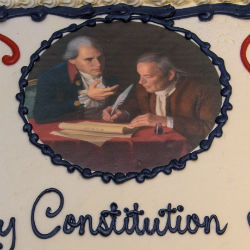 | 202009 17Celebrating Constitution Day
September 17, 2020
In 2004 Senator Robert C. Byrd of West Virginia introduced legislation designating September 17 of each year as Constitution Day and requiring public schools and government offices to provide educational programs to promote a better understanding of the Constitution. The Senate’s annual Constitution Day event, sponsored by the Office of the Secretary of the Senate and presented by the Senate Historical Office, has become a favorite Capitol Hill tradition.
More than two centuries after its ratification, the United States Constitution remains a fundamental document. Strengthened by amendments, it continues to guide our public officials and the people they serve. It has endured through civil war, economic depressions, assassinations, and even terrorist attacks, and remains a source of wisdom and inspiration. To encourage Americans to learn more about the Constitution, Congress established Constitution Week in 1956, to begin each year on September 17—the date in 1787 when delegates to the federal convention signed the Constitution. In 2004 Senator Robert C. Byrd of West Virginia took it a step further, sponsoring legislation designating September 17 of each year as Constitution Day and requiring public schools and government offices to provide educational programs to promote a better understanding of the Constitution.
Appropriately, Senator Byrd kicked off the Senate's first Constitution Day celebration in 2005 with a speech in the historic Caucus Room in the Russell Senate Office Building. He shared his personal devotion to the Constitution (a copy of which he always kept in his pocket) and stressed the importance of educating Americans about their founding document. "Just as the birth of our nation depended on the quality, knowledge, and experience of the men who gave it life, its continued vitality depends on the efforts of our generation, and of future generations, to keep the vision of its Framers alive," Byrd stated. "It depends on the personal commitment of each and every one of us to learn, to understand, and to preserve the governing principles that are set forth so clearly and powerfully in the text of our remarkable Constitution."
For the Senate Historical Office, Constitution Day has been an opportunity to explore the ways in which the Constitution has shaped the Senate, the role of the Senate in amending the Constitution, and how the Senate has exercised its constitutional prerogatives and fulfilled its constitutional duties. The annual event has examined the debates of the federal convention in 1787 that led to the creation of the Constitution, the heated arguments of the state ratification process, as well as the nature of federal elections under the Constitution and how Congress has changed the electoral process over time.
These events also have examined how the Constitution has been amended, from the adoption of the Bill of Rights in 1791 to the passage of the Seventeenth Amendment providing for the direct election of U.S. senators in 1913 and the Nineteenth Amendment providing for female suffrage in 1920. Other topics have included the Senate's constitutional role in the treaty-making process and the various constitutional crises confronted by the Civil War Senate, including defining a quorum in the wake of secession, Civil War amendments to the Constitution, and the readmission of states to representation after the war.
In recent years, Constitution Day programs have expanded to include guided exhibits featuring facsimiles of historic documents, maps, and images. In 2016, to commemorate the 200th anniversary of the creation of the Senate’s first permanent standing committees in 1816, Senate historians and archivists created four archival exhibits that demonstrated how committees aid the Senate in exercising its powers under the Constitution. Highlighting the work of four committees established in 1816 (Foreign Relations, Finance, Judiciary, and Commerce), these exhibits illustrated how Senate committees provide a forum for constitutional government in action.
Using case studies from different eras, the documents revealed how Senate committee work has changed since 1816 and highlighted the growing role of committee staff. In the 20th century, as the nation grew to superpower status, the Senate reformed and modernized its committee structure, allowing for increased professional staff who brought their expertise to the legislative and oversight process. For the many staff members attending the event, this served as a reminder of the vital role they play in Senate history and the continuing importance of archiving committee records.
In 2017 the Senate’s Constitution Day event focused on the contentious debate during the Constitutional Convention of 1787 over representation that culminated in the Great Compromise of 1787, the agreement that established state equality rather than population-based representation as a defining characteristic of the Senate. Following a brief historical presentation, those attending the event explored archival exhibits illustrating the debate that produced this compromise, how the compromise was received during the ratification process, and its enduring legacy.
Constitution Day 2018 examined how the constitutional provision for equal state representation in the Senate led to fierce battles over the admission of new states. Article IV of the Constitution specifies that "New States may be admitted by the Congress into this Union." The Constitution also gave Congress the power "to dispose of and make all needful Rules and Regulations respecting the Territory . . . belonging to the United States." The Constitution, the 1787 Northwest Ordinance, and later treaties under which the U.S. acquired new territories—such as the Louisiana Purchase Treaty of 1803—governed Congress's practices for organizing territories and setting conditions for statehood.
Only after territories had served a period of tutelage and built up the requisite population and economic resources could they apply to Congress for equal status as a state. As Assistant Historian Daniel Holt explained in his Constitution Day 2018 presentation, the Senate frequently “took center stage in the often-contentious battles over admission of new states. Each additional state has held the potential to upset the existing balance of power in the Senate." To accompany this event, the Historical Office created an online feature entitled "On Equal Footing: The Constitution, the Senate, and the Expanding United States," which included historical information and the archival exhibits from this presentation.
The Constitution of 1787 established the framework for the United States government, but it has fallen to succeeding generations to interpret and implement its principles. Every year, Constitution Day provides the opportunity for citizens to revisit the nation’s founding document and examine how it shapes this nation more than two centuries after its ratification. The Senate Historical Office welcomes this annual opportunity to continue its explorations into the origins of the Constitution and its role in the history of the United States Senate.
|
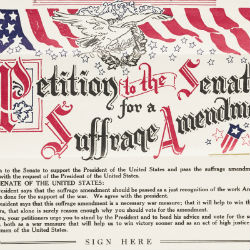 | 202004 02Discovering the Role of the Senate in Women’s Fight for the Vote
April 02, 2020
Congress Week—celebrated each April to commemorate the week in 1789 when the House of Representatives and the Senate first achieved a quorum—was established to promote the study of Congress and to encourage a wider appreciation of the vital role of the legislative branch in our representative democracy. This year, in recognition of the centennial of the ratification of the Nineteenth Amendment to the Constitution, we celebrate Congress Week by exploring how Senate historians used congressional collections to develop the online feature, “The Senate and Women’s Fight for the Vote.”
Congress Week—celebrated each April to commemorate the week in 1789 when the House of Representatives and the Senate first achieved a quorum—was established to promote the study of Congress and to encourage a wider appreciation of the vital role of the legislative branch in our representative democracy. This year, in recognition of the centennial of the ratification of the Nineteenth Amendment to the Constitution, we celebrate Congress Week by exploring how Senate historians used congressional collections to develop the online feature, “The Senate and Women’s Fight for the Vote.”
Formally proposed in the Senate for the first time in 1878, the Nineteenth Amendment was finally approved by the Senate 41 years later, on June 4, 1919. Ratified the following year, the amendment extended to women the right to vote. To tell the story of the suffragists’ protracted campaign to win that right, Senate historians delved into a variety of primary sources, including petitions, congressional hearings and reports, and the personal papers of U.S. senators.
Records of Congress
The Center for Legislative Archives at the National Archives (where congressional records are stored) houses a vast collection of woman suffrage records. The bulk of these records consists of petitions created by tens of thousands of suffragists who exercised their First Amendment right. Their petitions come in all shapes and sizes. Some of them are as brief as a telegram, while others include hundreds of signatures pasted or stitched together and rolled up in large bundles. Senate historians combed through scores of petitions to understand not only the suffragists and their demands but also those who opposed woman suffrage.
Senate historians also consulted speeches printed in the Congressional Record and committee hearing transcripts and reports to understand senators’ evolving attitudes toward woman suffrage. When California senator Aaron Sargent introduced the woman suffrage amendment to the Constitution in 1878, the Senate Committee on Privileges and Elections agreed to allow women to testify in support of the amendment. After hearing from witnesses, including suffrage pioneer Elizabeth Cady Stanton and the Reverend Olympia Brown, the committee’s majority remained unconvinced and recommended that Sargent’s proposal be “indefinitely postponed.” A few senators voiced their dissent. “The American people must extend the right of Suffrage to Woman or abandon the idea that Suffrage is a birthright,” concluded Senators George Hoar (R-MA), John H. Mitchell (R-OR), and Angus Cameron (R-WI).
In 1913, following a historic suffrage parade in the nation’s capital, a Senate subcommittee investigated the chaotic and hostile conditions endured by suffragists along the parade route. The voluminous testimony and photographs published in these hearing volumes provide compelling evidence of lewd comments, physical assaults, and intimidation, as well as the volatility of the massive crowds of people that converged along the parade route. In the wake of these dramatic hearings, the committee concluded that the police had acted with “apparent indifference and in this way encouraged the crowd to press in upon the parade.”
Senators’ Papers
To delve deeper into this rich and engaging story, the historians also ventured outside the Senate’s official holdings at the National Archives to explore the personal papers of individual senators and suffragists, as well as the records of suffrage organizations housed in the Manuscript Division of the Library of Congress. Correspondence between senators and their constituents often revealed the motivation behind a senator’s decision to support or oppose the amendment.
Idaho senator William Borah, for example, who opposed the national suffrage amendment, insisting it was an issue best left to the states, justified his opposition to the amendment in letters to concerned constituents. “I am aware . . . [my position] will lead to much criticism among friends at home,” he wrote. “I would rather give up the office,” he continued, “[than] cast a vote . . . I do not believe in.” Wisconsin senator Robert La Follette succinctly explained his support for the proposal in a letter to Anne Fitzhugh Miller: “A government of equal rights cannot justly deny women the right of suffrage. It will surely come.” Like the petitions in the National Archives, such letters offer a palpable sense of the engagement of citizens with their senators.
Organizational Archives and Other Primary Sources
Senate historians reviewed archival materials housed at the National Woman’s Party (NWP) at the Belmont-Paul Women’s Equality National Monument, including materials related to the organization’s complex lobbying operation and a political cartoon collection by artist Nina Allender. Many of Allender’s cartoons prominently featured the Senate.
A deep dive into the extensive photographic collection at the Library of Congress turned up a host of illuminating images to illustrate suffrage campaign activities at the Capitol and the Senate Office Building, as suffragists assembled to deliver their petitions and to demand the right to vote.
An exhaustive review of historical newspapers and periodicals revealed personal testimonials and editorials. Particularly informative was the series of articles written by suffragist Maud Younger and published in McCall’s magazine in 1919, just after congressional passage of the amendment. Entitled “Revelations of a Woman Lobbyist,” Younger’s intimate account provides an insider’s view of the extensive lobbying campaign suffragists waged to win House and Senate approval of the Nineteenth Amendment.
Primary sources such as photos, petitions, speeches, published hearings, correspondence, historical newspapers, and periodicals are all essential to the historian’s work. Our special feature, “The Senate and Women’s Fight for the Vote,” which drew upon all of those resources and more, demonstrates the value and importance of congressional archives. Without these records, the important role played by suffragists and their allies in the Senate’s long battle over the suffrage amendment would be lost or forgotten.
|